Showing posts with label Baynard. Show all posts

Thursday, April 16, 2026

Continuing on the same theme

The origin of this crest used by the Calne Blake family is a mystery? I am curious if it is a French coat of arms that the originating le Blake/le Blak family used in France and decided to change to the arg. a chevron between 3 garbs, sab. which is the usual arms associated with the Blake family at Calne (and some individuals at Andover although always penciled in rather than printed).

A little more searching has brought up another interesting publication of the Alphabetical Dictionary of Coats of Arms and on page 1023 I found the following:

Arg.  a pile issuing out of the chief az. charged with three martlets, or.                Blage

Slightly different from the Blake crest used by the family at Calne and Andover but the surname attached to it is rather interesting - Blage. It is an aside though and not part of the Blake Family of Andover; just interesting. I do tend to pay attention to interesting asides on occasion. 

http://openlibrary.org/books/OL7130641M/An_alphabetical_dictionary_of_coats_of_arms_belonging_to_families_in_Great_Britain_and_Ireland

 
Does all of this detail constitute another chapter I wonder  and perhaps I will do that at the moment and label it Chapter 7 - Thoughts on the Blake Fraud created by Horatio Gates Somerby.

It is mostly created in these blogs and just needs to be organized a few more images inserted and I rather think that I will do that. 

I did speak to the College of Arms when we were in London about the footnote on the Blake Pedigree that said family records had been used. The College did not retain those records and they suggested I write the family. Not really have knowledge of this family line as to whom to write  however I continued pursuing the documents that are available and the comments made by other genealogists through the years. 

I was sort of surprised when I discovered some of the information as the Blake family at Calne had refused to accept a knighthood and for that Pynhills was basically demolished by King Charles I's orders. When my great grandmother's cousin Sir John Carling was knighted the family, according to my grandfather (who repeated it to his wife and children later), were very pleased to see this  honour bestowed on one of their own. Interestingly my grandfather used to say that people having titles live in a fishbow. When Edward was first unwell in 2011 I decided to acquire support letters in favour of his being nominated so that Edward would receive the Queen Elizabeth II Diamond Jubilee Medal and he was thrilled to receive it. It now belongs to his grandsons as a Medal which was given to their grandfather. So I can understand why people would be excited to receive such honours but I also understand why people avoid it. Edward was thrilled; he loved to be the centre of attention. 

I note that just three years after Sir William Blake received the knighthood he passed away so perhaps a lot of this misinformation on his family line coming down from John Blake and Margaret (Blake) Blake is a product of his not being available to make any corrections; no ideas on that. Daniel Blake, the family member who worked with the College of Arms to produce the Blake Pedigree Chart,  was not directly descended from Sir William Blake. Daniel was the son of William Blake and Margaret Fountain with this William being the son of Thomas Blake and Eleanor (Hall) Blake (Thomas was a brother to Sir William Blake). This Thomas Blake was also a son of John Blake and Margaret Blake which takes us back on this chart to William Blake and Avis Ripley (the suggested extra son for Roger Blake and Mary Baynard for whom there is no documentation). On the Blake Pedigree Chart this William is said to be of Easton Town alias Essington near Andover, Hampshire. 

The will probated for William Blake of Easton Town 1582 is actually the will of William Blake of Eastontown near Andover dated 27 Jul 1582 and probated 14 Nov 1582.  He names his brother as Edmunde, his sisters as Elizabeth and Alice which fits him very neatly into the family of Nicholas and Margaret Blake. His eldest son was John Blake married to Margaret Blake (the parents of Sir William Blake). William (father of John Blake)'s wife was named Elizabeth in his will but I am suspicious that he was married twice. Still working on that. This William, in his will of 1582,  includes mention of the Blake family of Speen, Berkshire in his will which is significant as I believe this to be the le Blak family of Rouen, Normandy and later Wargrave near Windsor, Berkshire that eventually, as they moved towards Calne, used the spelling Blake for their surname. One does not have an impression that they were anything beyond friends these two Blake lines (at Andover and Speen) reading the will. If there was a relationship as I have suggested it was the individual living at Enham in the 1300s who married into the le Blak family (namely Alice la Blak or another; why is Alice in Hampshire in the records along with a couple of other le Blak) and took her surname. That it would be a reasonable thought comes from the idea that Britons did not have surnames until the coming of the Normans and taking on the surname of a Norman offered huge advantages for sure (particularly security). 

Paying attention to the news for the  moment and pleased to see a Majority Government - I think of it as a Unified Government to be honest that will support the rapid transition of Canada from a somewhat dependent country to a more free-standing country which we were right up until the early 1960s. Perhaps it is a sort of deja vu that it is the Liberal Party that is re-working their time in government since the late 1990s when our military was no longer properly supported and we were rapidly slipping into too-dependent a relationship on our neighbour although it was equally enjoyed by both and then included Mexico as well and has been beneficial to all of us. Now as the government once again the Liberal Party is busy building up our military, encouraging industry to diversify its trading partners both within Canada and around the world. Prime Minister Carney is ideally suited I will admit to being that guardian of Canada at this time and in this place. His experiences, his knowledge all being put to use as our trade around the world increases rapidly and our attention to the potential of more pipelines and mining the rare earths and minerals will rapidly increase. His ability to stand back and let his Cabinet and the members of his party be very much part of this growing process is very much to his credit and seldom seen in government. The desire to be part of that particularly if you have been in opposition in the Conservative Party or the NDP (I do think Avi Lewis will be a good leader although unlikely I would ever vote NDP except perhaps for Wab Kinew if he ever goes federal) or the Green Party is very understandable - knowing that your skills are such that they will improve the ability to move this along more quickly. I would support my candidate if they happened to be Conservative moving to the Liberal Party at this time. I think we have to be wise and attentive to make the most of our opportunities in the world. Our relationship with our good friends and neighbours - the United States and Mexico - continues to be something we would like to see carry on but we leave that up to our government to seek the best trade deal for Canada and for all of us in North America. Our trading relationship has been the best in the world and we all benefit. We too lost some of our home-grown industries and we will re-invent them over time if necessary in order to support our economy. But in essence we had no complaints really about CUSMA. It provided a good life for North America. 

No more news for awhile I must work on the books; they are my life work I believe although I am very late in starting as they were begun when I was 79. 

Tea all drank and must do my Solitaire Puzzles to sharpen the brain.  Cleaning all completed and breakfast soon.


Wednesday, April 15, 2026

Wiltshire Archaeological and Natural History Magazine Volume IX, 1866

 Volume IX of the Wiltshire Archeological and Natural History Magazine, published under the direction of the Society (formed in that County A.D. 1853) looking at Pages 223-224. There is an article which discusses descent and arms of families and was written by Mr. Clarence Hopper. He was using the notes of the Richmond Herald at the College of Arms appointed in 1721 and the notes referred back to Robert Dale (possibly he was an heraldic painter prior to  his appointment as Richmond Herald at the College of Arms). The information was principally from the time period of the Visitations of 1620. The notes were on the Blague/Blake/Blaake family. Looking back at the Visitation of 1565, Roger Blake and Mary (Baynard) Blake had three sons according to this Visitation namely Thomas Blake living at Pynnell, Robert Blake living at Lacock and John Blake living at Hilcott. Perhaps most startling they did not have a son William. 

The Blake Pedigree Chart is available for purchase from the Swindon and Wiltshire Archives and I did purchase eight images of this Chart which is 12 feet by four feet. 


It is this family in the centre pretty  much of this chart that is of interest. It is Roger Blake and Mary Baynard and their children. 


 Lifting this information out of the chart and enlarging it slightly the children are mentioned as Thomas, Sibil, John, Joane, William, Mary and Robert. The wills of Roger and his wife Mary (their parents) are semi-helpful. Although Roger only names Thomas (the eldest) and Mary (the youngest) in his will. Mary however mentions her sons Thomas, John and Robert. It is really a strange thing that William is not mentioned in one of  these wills. Even more interesting that Edward J Blake moves this William back several generations to another family on this same chart in terms of content and has the Hampshire Blake family connected at that point. But the individual who eventually was appointed the Richmond Herald at the College of Arms wrote in his notes (in 1693) I note that the College of Arms produced the first Blake Pedigree in 1690 and later additions were added in the early to mid 1700s:

Blague/Blake/Blaake family [these two alternative spelling are very interesting and I did find some information on Blage as a surname; doubling up the a sort of inconsequential I think]

Dorsetshire, 27. Blague, alias Blaake, now Blake of Quemberford [Quemerford], Calne and Pynhills - 1st, arg. a chevron between 3 garbs, sab. [this is the usual arms associated with the Calne Blake family but it was penciled in on the Andover Blake family in the Visitations]. 2nd, arg. on a pile, az. 3 martlets, sil. both by this name. Crest on a chapeau, gu. turned up erm. a martlet, arg. Kent 83.

Blague of Lacock, a second branch from Quemberford. Kent 83

Blague of Hilcot, a third house from Calne. Kent 83

This fits in with the Visitation of 1565 which states that Roger Blake and Mary Baynard had three sons - Thomas at Pynnell, Robert at Lacock and John at Hilcott which matches the information found in the Wiltshire Arms and Descents article mentioned above.

Why was Edward J Blake so interested? I suspect he was providing proof that the Somerset Blake line at Plainfield was descendant of the Calne Blake family. I have written about that and I suspect that they are actually. But a yDNA test for this family has not yet appeared with conclusive genealogical tree evidence as far as I know. I need to go into the yDNA results at FT DNA this next newsletter for Blake and perhaps write about that. It could drum up interest perhaps as sometimes when I write articles that directly refer to the study new testers do appear.  

All of this information fitted in perfectly with what my grandfather had said about Nicholas Blake being given siblings he didn't have and parents that were not his but still living at Old Hall, Enham. Why would he even talk about it I did wonder as I under covered all of this information. The reason somewhat obvious in that Horatio Gates Somerby's private book was published after his death. Other genealogists through the years have written on this very item and have declared Somerby to be a fraud writing "fancy" books to please people thinking that no one would ever find his machinations (they were private publications) and that he was quite safe writing such books perhaps. One of these genealogists was Paul Reed publishing an article in The American Genealogist (TAG), Volume 74, 1999 (Two Somerby Frauds or "Placing the Flesh on the Wrong Bones).  

Basically the remainder of this chart above is mostly committed to the descendants of this William Blake of Easton Town (Hampshire) who died in 1582 and indeed there is a will for such a person but his father was Nicholas not Roger. 

Today is the basement cleaning day and this week has been a foray on my part into dealing with an item that had to be fixed. Namely my eavestrough. It is now fixed and I thought to get ahead of myself and set up an appointment in a month or so to have the eaves troughs cleaned out that we can not reach readily. I sort of regret it now as I do really hate having to enter back into the real world and so I will think about it for a bit because I just simply can not deal with so many new people. I am 80; that is normal for 80 really. I just want to work on my books. But I am pleased with the repair on the eavestrough - all fixed and the draining is as it should be; it no longer looks like it will fall off and indeed when he placed the ladder against it I was surprised that it was so solid. Anyway all done and it took him maybe 40 minutes but he was very efficient. I must say that. The Insurance Company that looks after the house has the link that takes you to this company and you send it the work you want done and a quote comes (actually two quotes). I just wanted one. I simply didn't want to deal with a whole lot of people but two quotes is probably a good idea. However, I sent off my requirements once again and got back a quote and I shall soon reply but must run it by my family and they are busy at the moment so will wait a couple of days. I am sure these people are very busy people - people in the trades are run off their feet I think often enough these days. There are not enough of them and I find that strange as the tools in the trades are fascinating. It is a busy life and you are not sitting behind a desk and many times now it is an AI doing the work that you were doing anyway. Going into the trades is a good move these days. Both my father and my grandfather were well read people and had very intelligent conversations but they chose the trades and they loved being in the trades. It is simply a different way of working and much healthier I think that sitting at a computer. My father was 94 years old when he passed back in 1998 and my grandfather was 79 years of age when he passed back in 1953. Both of these ages were quite good to live to in that time frame. They had very good retirements especially my grandfather as my father had a stroke which took away the use of his legs sadly at 88 although he was still working when he had the stroke. But still when I visited all day perhaps four or five times a year (sadly actually as I would have gone oftener if I lived closer) we had some lovely conversations that still come to mind. As I recall he did talk about the Blake family and the book that Edward had written (I did the leg work) and some of what he said reinforced what Grandpa had said. Interesting contemplating that. 

I will deal with the eaves trough cleaning soon but not today (actually my daughter cleaned the ones that she could reach readily which were full because of their location. The one at the front is likely full but the back ones never have much in them when Edward cleaned them. I need a rest away from people. Family is fine but I have spent too much time with people in my 80 years and now I just want to be away from people as much as possible unless they are family. I have done my work helping people for twelve years at the hospital and other jobs before that plus all that volunteer work; it is time for me to have a rest from people. 

Will this book of mine get published? I rather think it will although I am still debating some of the chapters that I might embargo and only publish in the copy I put into the Guild of one-name Studies Library and perhaps Family Search as they also do embargo I believe. I shall be careful to say that some of this is my thoughts and opinions based on conversations as a child with my grandfather and my father (although those conversations were as a child as well as an adult). 

Must do my solitaire puzzles but first breakfast. I am hungry. Listening to people having trouble losing weight; I am the opposite I tend to run it off in the day and have to remember to eat more or it slowly sinks down perhaps just a couple of pounds but I usually weight myself most days and then put effort into eating a bit more and bake my favourite banana bread which has 3/4 C of brown sugar - very tasty especially buttered. I prefer to butter cake rather than icing on cakes. I do not have a sweet tooth.  


Friday, February 7, 2025

Is the John Blake (son of Robert Blake) the same John who was a parliamentarian?

 Still working on the latin document and have picked my way through different parts of it. I  have to think how families that were prominent managed. The Pedigree lists the son of Richard Blague/Blaake/Blake as Henry and there isn't anything (as there is with the Baynard) to show a break (i.e. generations missing) in that chart so his son was said to be Henry and that he was son and heir. Now in British families at this time primogeniture ruled the path so younger sons would go into the military, the church or parliament. If we assume that John was a younger son of Robert (we know this to be correct because the document names Robert Blake (deceased), Joan (unknown) Blake widow, and John the son) then Robert would have had to have been a younger son perhaps since there isn't a Robert on the chart for several generations and that Robert had a Fulling Mill at Quemberford and was married to Avice (Wallop) (Malewyn) Blake. The document is dated 1386 and we know John Blake I (as listed in the Parliamentary Archives died in 1395 leaving a son John (7 years of age and born in 1388 so he is not the John in the document). What I want to gain from the document is some notion of the age of this John Blake I but haven't achieved that thus far. Since Robert was an adult at the time of the first record that I bought  in the 1330s then John Blake I was probably an older person when his son was born. The document synopsis states: "By Robert Devenyssh to Joan widow of Robert Blake and John her son of all his lands in Shawe by Savernake which he acquired from John Wyleye and Robert in Echelhampton. Witnesses: John Lye, John Warneford, John Webury, etc. Dated, Shawe, Fri Feast of St James [25 July] 10 Richard II [1386]. Seal. [Deed damaged by damp - text faint and illegible in places]." 

Perhaps I should be interested in why Robert Devenyssh passed this property to Joan (perhaps he was more interested in it going to his grandson) but I am somewhat suspicious that he was her father and the property was actually going to John himself - no ideas on that but it was perhaps promised at the time of the marriage as part of a dower but to pass to a grandson but again I haven't read the entire document yet. We will see. Anyway wanted to put this down since I was thinking about it. I did do a blog on this Robert Blake determining his proof of life at various times and the first presence I found for him was around 1310 but he would have very young at the time as I was working backwards from a document in the 1330s when he was likely an adult. This Robert did not appear on the 1301 Pipe Rolls for Wargrave but a John le Blak was at Wargrave with Richard le Blak and his daughter Alice la Blake. Since John Blake I died in 1395 leaving a seven year old son John Blake II one is left to think he was possibly older  (i.e. born in the 1330s) having served in Parliament a number of times - principally in the 1380s. That would perhaps place him in the 1380s in his late 40s or early 50s at that time if his father Robert was actually born circa 1310.

I want to have a look at the second document today as well. It is sharper and working with it will be easier. I will keep my blog up to date as I work away today.

Teatime.  

The second document was labeled as a land grant but it has a jagged edge which I understand is usually an indenture but this is a document from 1353 and perhaps when it was a transfer of land between two people they also used that method of recording (which I have now verified; this was an exchange of two acres between two people). So I have begun and this is in much better condition (but I did know that the other had weak spots and fuzzy in places; they say it in the catalogue) and it is between Robert le Blake and another individual. So in 1353 he is old enough to be managing property. Neither his wife Joan or his son John are mentioned in this document. John Blake I would have been born perhaps not long after this although difficult to determine that but he is old enough in 1386 to be on the document so likely by the early 1360s. Moving forward slowly. It is a while since I have read latin documents and this is older latin than I am used to since the wills I transcribed in Latin were from the late 1400s to the early 1500s. 

Is  he the same Robert Blake all the way through? That is always the question in my mind but the land that is being discussed is Kemerford (an earlier name for Quemberford). It is sort of hard to believe that the Blake found at Quemberford in the early 1400s wouldn't be the same Blake family but it is still I think necessary to find as much as I can to support that this is a continuous line of Blake (same family) at Quemberford through the 1300s into the 1400s and still in the 1500s. 

Good day thus far as I have done my Yoga, I cleared away the snow on the patios and then ran for 30 minutes and walked for 15 minutes. This afternoon, after a little more work, I will either do weightlifting or rowing. 

We are not going to be hit with double digit snow levels this weekend only about 5 cm. Sounds good and the more the merrier. The snow is still not that deep in the yard, perhaps half of a metre and we need a metre and a half standing to really have good moisture in the spring. 

An interesting find when I did a quick search on Quemberford:

 https://www.oodwooc.co.uk/ph_quem_aub.htm

 It is a short history of Quemerford and Pinhill and there isn't a mention of the Blake name until the 1600s at Pinhills. There is a discussion on Quemberford which is also rather interesting:


 Wyly surname is on the grant that I am working on actually as a witness. But it is interesting that up to 1335 there is no mention of the Blake family being at Kemerford/Quemberford so this acquisition in 1353 is perhaps the beginning. I believe this plaque is in the Church at Quemberford and the image prepared by D. & M. Ball (as noted on the image above).


Wednesday, January 15, 2025

Cleaning will be finished today

Just the top floor to clean and then done once again for the week. Yesterday I cleaned the main floor as I decided to do three days of cleaning this week. I also shoveled the porch and patio at the front. I think that was a good plan not to have the company shovel the porch and patio as it does get me outside in the fresh air at least occasionally. 

I continued to work on the Pedigree Chart yesterday and may do some more today on the first image. I discovered British History Online is doing an upgrade to their system which allows me to continue searching but I could not become a member of the site although do have a login now. I did a little searching on Dorrant and Bellet. The Pedigree Chart has scant information on these two lines that appear to have married into the Blake family of Wiltshire. The Baynard family is well established and known in the Visitations and other documents as well as having wills for many of the members of the family in this timeline which I have transcribed. I wonder if that was the upward movement of the Norman family le Blak (still not yet proven the idea that the le Blak family of Wargrave, Berkshire was the Blake family of Calne) actually marrying into the Baynard family - Roger Blake and his sister Anne married into the family. Roger married Mary Baynard and Anne married  Robert Baynard but they are great grandchildren of Philip Baynard and Henry Blake (the second set of circles on the first image). This first image does proves to be rather interesting. There is also a Blake Pedigree Chart held by the Blake Museum in Bridgwater which is equally interesting and has ten images available online at the Museum site. 

First Image of the Blake Pedigree at the Blake Museum in Bridgwater:


I have discussed this particular set of data before on my blog. We can see the same or similar marriages and I think this was prepared in the latter part of the 1800s. The second image (referred to as Sheet No. 2) does have a slightly different look at the Blake family of Andover than this Pedigree Chart.

Second Image of the Blake Pedigree at the Blake Museum in Bridgwater (I have cropped it from the original image to show the Andover Hampshire material):


 In a way it is like the author of this second Pedigree Chart has anticipated and noted the problems with having a William Blake at Eastontown as the son of Roger Blake and Mary (Baynard) Blake and devised a connection further back descendant of Henry Blake married to Margaret (Bellet) Blake. There is actually a simpler connection I think even further back with a John of Enham marrying Alicia (la Blak) daughter of Richard le Blak who lived at Wargrave likely whilst they were living at Wargrave and that would have been in the early 1300s and that would eliminate the inconsistencies with the wills of the Blake family of Andover created by these two charts. I will discuss this chart line by line as well since I have a lot of information from the wills to help to simply and revise this portion.

So that is my purpose in the next month to examine the extant material and see what is available. I have really three sets of thought all based likely on family lore. The First Pedigree Chart created by the College of Arms with information provided by the Daniel Blake family using the Visitations and family data which is not found online was a simple direct connection back to William Blake of Eastonton but he is not given the right set of parents according to the wills. The Second Pedigree Chart created by I think Edward Blake of Crewkerne, Somerset who did provide information to Horatio Gates Somerby so likely why this information in the Second Pedigree Chart resembles that idea and the Blake is an unknown coming out of Wiltshire to Andover and a son of Henry Blake if one follows the traceback to the first page of this second Pedigree (great grandfather of Roger Blake said to be the father of William Blake of Eastonton). This second chart does utilize the power of the wills as far back as they would take you although I need to verify the information on this chart with the extant wills. I have transcribed all of them. This Second Pedigree Chart links the Somerset Blake family to the Calne Blake family and again this is hinted at in the first Pedigree Chart which we will reach eventually. My thought remains the simplest that the Andover Blake family is linked through a female line way back in the early 1300s. This would fit in with my grandfather's thought that such a relationship could have existed (as family lore did exist but he tended to be somewhat skeptical of it I think) but more likely with the Blake family of Berkshire as in retrospect he appeared aware of a relationship between these families from earlier times. As I researched I did recall his mentioning that (I was only eight when he passed although he was quite lucid to the end of his life; just fell asleep a lot while he was telling me stories!). I loved it though to sit and listen to him and would do that for hours as my father used to take me to the office and let me sit and chat with him whilst he was working. My grandfather used to keep the equipment sorted for him and he also built scaffolding when he needed that for construction. Proving the link between the Somerset Blake family and the Calne Blake family I will leave to others. I sometimes think where there is "old" family lore one has to look at it as a possibility but finding the information when you are looking back into the 1600s and earlier can be quite difficult. My grandfather though was quite positive that we were not related to Lord High Admiral Robert Blake of Bridgwater (I think that was still important in the 1800s but time tends to gloss over these things!). But that was likely more of a political statement clearly separating his Blake family from Cromwell. Isn't history fascinating really? Between my new found depth of vision and all of this history ( my cousin George Dekay (he asked me to write a Profile for the Pincombe family for the book he was editing) certainly set me on a different path than I had planned for my retirement) I am totally distracted for sure and the days pass by rather quickly. I continue to see more items in that oil painting of the winter scene in Canada. The painter is certainly obscure and the painting itself of little value but the picture is tremendous.

I also want to get back to my son in law's family which traces back to 30+ of the early families in Quebec (and some Acadian further back with some of those lines now in New Orleans). I do have a Pedigree Chart for my lines back which includes my son in law's lines but I still need to extract more data that is available. Most of the families I have taken back to France at least one generation. With all of Edward's work on the Kipp side (his early colonial ancestors are many and for the most part they remained in the United States until the 1820s/1830s when free land became available in Upper Canada although his Kipp line came in 1800 from Northeast Town in Dutchess County New York (on the 1790 census)), the lines for my daughters tend to be mostly in North America back into colonial days except for my father being born in England and coming to Canada as a nine year old with his parents in 1913 (my mother's family arrived in 1818 for the earliest settler but each subsequent marriage in that line was with an English immigrant - amazing really). A link between the Kipp family and Thomas Horner does give one a thought on why Isaac Kipp made the move to Canada in 1800 (free land was available then as well for settlers although a lot of them tended to be loyalist but with a father in law that was patriot I think that was unlikely (Isaac was born in 1764 and finding his birth parents knowing his baptism/birth has been impossible but the yDNA match with descendants of the Kip family of New York/New Amsterdam did make the way back obvious!). I am not an expert though on the Kipp family and his work is online on Edward's website. Interestingly many members of this Kipp family are now back in the United States have gradually moved back from the middle 1800s to the present.

I also worked extracting more atDNA matches from My Heritage and this will be a long process as I found at least ten new ones on the first page of my matches alone. I figure that I need to read through the first 35 pages of matches to eliminate anyone who does not match me by at least (or one of my siblings) 20 cM on one length. Many of these matches are in the fourth cousin range with total matches of between 40 and higher cM. But I am back into working on what I wanted to do although I do need to send the Companion Charting Book for the Siderfin Family to repositories and the Guild. So will also get that done soon. 

Teatime and then breakfast. The day moves quickly. It is minus 11 degrees celsius and cloudy. A sort of normal January although not quite as much snow cover as usual. It is this lack of snow cover which is the largest problem.


Friday, January 10, 2025

le Blak and le Blake

Reading through the 1200s and 1300s in the Archives (National Archives of the UK) and the really great part of this archives is they also include the Archival databases of the counties in England and other (like Berkley Castle). Eventually the Calne Blake family does end up in Gloucestershire after their mansion house at Pinhills is destroyed by Charles I because Henry Blake would not take a title. But interestingly I am also finding the le Blake family at Cam, Gloucestershire in 1332 leasing land  and the distance to Calne, Wiltshire is close enough (about 50 kilometres). 

Richard le Blak was on the Pipe Rolls at  Wargrave, Berkshire in 1301-2 and with him his daughter Alice la Blak and there is also a John Blak at Wargrave. Near to Wargrave there is Hamo Blak and his son Walter Blak at Waltham St Lawrence. This group of people does rather interest me because there are wills for the Blake family members in the 1500s written in the Speen Berkshire area that mention the Blake family in Andover. It is about 60 kilometres by present day roads which wind about somewhat so perhaps 50 kilometres or could be less. The interesting part is that Speen is closer to Wiltshire and just north of Andover. It may simply be coincidence and I want to avoid convincing myself that the le Blak family found at Wargrave is the Blake family of Calne unless I can find adequate proof. There are a lot of pluses for this thought - this was a Norman family granted a market license in 1274. Certainly Normans often received steps up from King William (Duke of Normandy) although this is two hundred years later. Most influential people were Norman but not all; many of the lords of the manors who existed before the arrival of William the Conqueror were still on their lands (although paying fealty to a Norman overlord for sure).  

The Pedigree Chart for Blake prepared by the College of Arms with material provided by the Daniel Blake family of London in 1690  and this is the top of the Chart.


 This beautiful manuscript is about four feet by twelve feet and is held by the Swindon and Wiltshire Archives. It is possible to purchase eight images that include all of the chart by writing to them. The cost is quite low actually. 

The beginning text reads: "The genealogie of the ancient and worthy family of BLAGUE, BLAAKE or BLAKE, of great antiquity in the county of Wilts, where they had large possessions in Quemberford, Calne and Hilcot with a fair mansion house called PINHILLS, now the seat of the family, a younger branch whereof transplanted themselves into Hantshire and settling at Easton Town, were owners of that and divers other mannor from whence the BLAKEs of Middlesex, etc. are immediately descended faithfully collected out of the several visitation books of the said counties remaining in the College of Arms and deducted to the issue of Daniel BLAKE of London, Anno 1690."

William Blake at Easton Town died in 1582 and this chart is produced just over 100 years later. His will, and over time I have discussed whether there was a possibility of two William Blake individuals living in this area but I have not found anything that would prove the presence of two William Blake lines other than this chart (further down) and the visitations of one particular family. The question in mind though is did Horatio Gates Somerby come across this information and simply link this William to Nicholas because of the wills of both William and Nicholas but then decide on the basis of the Visitations that this was a family descendant in the male line from the Calne Blake family? It is interesting and I have been on this route before but I believe I will devote the next couple of weeks to really looking intently at all the information I have collected; discover if I need to order any more material although I do have quite a bit already and then perhaps make a general conclusion on my thoughts and then move forward to the next stage of the book. It is at such moments that I ponder the thought of being there in Winchester going through the old records but I will leave that for another as it will merit a great deal of attention in the years ahead and I remain with the thought that what I have accumulated can be placed with restrictions to family only and academic researchers. I do not want anyone to publish my work beyond what I publish but using my transcriptions, thoughts and other proofs they can do as they wish with that information.

Time for yoga very shortly. This morning has been very productive thinking wise and I like to have these moments when I just stop and think about what I am doing and where I can go next. 

One of the problems with the text above from the parchment Pedigree is taking the line at Andover back to Roger Blake and Mary Baynard and naming a son William. I have never been able to find in the wills or the Visitations or any other document that they had a son William. That the dating of the death of this William Blake in 1582 and there being a will for a William Blake at such time is provocative because he identifies himself in that will by naming his siblings as the son of Nicholas. Interesting really and it will be an exciting couple of weeks likely as I work my way through everything I have collected including many old records. In my mind is the memory of my grandfather talking about Nicholas Blake and who  he was not. Why would they even do that as Nicholas died in 1547 leaving his will? He was not wealthy by any means although did hold land at Knights Enham. But the attachment of Blake lines to this William (lines that moved away from Andover in the 1600s) leaves one with a great deal to contemplate because a number of these descendants of the Andover Blake family much further down the line did move to America and became interested in their Blake ancestor (even going so far as to test their yDNA which is how I really got into this study of Blake because I have four brothers myself and did test two of them (one was already deceased) and the discoveries on their yDNA were most fascinating especially as they did bring home to me the memory of my grandfather saying this Blake line was always at Andover reminiscent of the language used by the First Peoples here in Canada. It is something that people say who have an extremely long connection to the land. Fascinating really. 

Time for Yoga.


Sunday, April 21, 2024

Another Sunday and Blake work yesterday

Another Sunday in Easter - the Fourth Sunday and Church is online in Southwark. My Buller family lived in Bermondsey and attended St Mary Magdalene (also the Beard family as Christopher Buller married Mary Beard at All Hallows Barking by the Tower, London, 30 Dec 1794 (I think it might have been a runaway marriage although Mary was 27 and Christopher was 31 when they wed)) until sometime in the early to mid 1820s. Christopher Buller had been at St Olave as a young man and he was buried there along with Mary (Mary in 1806 and Christopher in 1832). I think perhaps the Church of St Mary Magdalene was the church of the Beard family but Christopher and Mary baptized their children at St Mary Magdalene where Henry Beard married Elizabeth Hemsley 31 Mar 1766. This is a fascinating family and eventually I will get to writing them up but they will be difficult. Perhaps I should be doing it now but God willing my brain will still manage to get around all of that material (plus my latin needs to improve greatly and I work at that every day (at least two times and usually three every day). It is marvelous having Duolingo - works perfectly for me. I also am working on my French but I am fairly efficient at reading but need to improve my spoken French and after one year (September 2025) I will pick up my German once again as it is mostly scientific and it would be interesting to speak a less restricted German. Why, no idea but I am enjoying it because I am a life long learner for sure. Breakfast next and then to Church online in Southwark. We walked and walked the streets of Southwark where the Buller and the Beard family lived. It was fantastic. The Church of St Mary Magdalene was beautiful but had been damaged during the Second World War but a very dedicated group of people are working on its renewal. There are so many churches that I could send money to in England but I have concentrated on the Cathedral here and about 66% of my tithe goes to PWRDF and the other 34% goes to general costs.  

The service was quite wonderful; the homily amazingly perfect to my thoughts of the readings in this time. We have evil war ongoing for those who claim to be the only ones that are perfect in God's image namely Iran with their syncophants  Hamas, Houthis, Hezbollah and for some reason the Russians. They are all terrorists and must clean themselves from the inside for they are satanists. Thank you again for welcoming me from an ocean away to be part of this wonderful Anglican Service which included a young woman of Presbyterian background and someone from Ireland. So many young people as part of the service; the Church needs the youth as always to carry forward the word of God to the next generation.

Whilst working on Blake yesterday, I decided to have a look at the early Wiltshire wills of the Blake and Baynard families. It was an interesting trip actually and at first glance the Wiltshire Blake family wills did not mention the Andover Blake family in the 1500s and 1600s. I transcribed the Baynard family wills as well but I did not see that they mentioned Blake other than Henry at Pinhill. Diana, Princess of Wales, is  descendant of the Baynard family through the Montagu family.  

Diana, Princess of Wales and hence Prince William are descendant of this Baynard family (Mary Baynard and James Montague). Their son James Montagu married Diana Hungerford 30 May 1671 and their son James Montague married Elizabeth Eyles. Their son John Montagu married Sophia Wroughton 15 Dec 1748 and their son George Montagu married Charlotte Wroughton 9 Oct 1783. It was their daughter Georgiana Montagu who married Vice Admiral Sir John Gore 15 Aug 1808 in London. Their daughter Anne Frances Gore married 1st Earl Howe, Richard William Penn Curzon 9 Oct 1845 at Great Witley in Worcestershire. Their daughter Lady Mary Anna Curzon-Howe married 2nd Duke of Abercorn, James Hamilton 7 Jan 1869 in London. Their son James Albert Edward Hamilton, 3rd Duke of Abercorn married Lady Rosaline Cecilia Caroline Bingham 1 Nov 1894 in London. Their daughter Lady Cynthia Elinor Beatrix Hamilton married Albert Edward John Spencer the 7th Earl Spencer 26 Feb 1919 in London. Their son Edward John Spencer the 8th Earl Spencer married the Honourable Frances Ruth Burke Roche and these two were the parents of Lady Diana Frances Spencer. 

Interestingly the Andover Blake line from which Diana, Princess of Wales, follows:  Thomas Blake and Eleanor Hall were the twelfth generation back from Diana, Princess of Wales and Thomas was the son of John Blake married to Margaret Blake (her father not known to me for sure although a Pedigree chart mentions William Blake of Eastontown for both John and Margaret and there were not two by the records!). This John was the son of William Blake of Eastontown and William's father was Nicholas Blake of Enham (The Andover Blake family - William Blake (d 1582) did have a daughter Margaret but her husband was surnamed Jarvis - William left an extensive will). Returning to Thomas Blake and Eleanor Hall and their son Thomas Blake married Dorothy Mayowe and their daughter Mary Blake married William Newland. Mary Newland married Isaac Manley, MP. Their daughter Dorothy Manley married William Gore, MP and their son was Colonel John Gore who married Bellamira Munbee and their son Vice Admiral Sir John Gore married Georgina Montagu in 1808 (and the descent continues as above). Their daughter Anne Francis Gore married Richard William Penn Curzon, the 1st Earl Howe. Their daughter Lady Mary Anna Curzon-Howe married James Hamilton, 2nd Duke of Abercorn. Their son James Albert Edward Hamilton, 3rd Duke of Abercorn married Lady Rosaline Cecilia Caroline Bingham. Their daughter Lady Cynthia Elinor Beatrix Hamilton married Albert Edward John Spencer, 7th Earl Spencer. Their son Edward John Spencer, 8th Earl Spencer married the Honourable Frances Ruth Burke Roche. Their daughter was Lady Diana Frances Spencer married to now HRH Charles III, King of England. 

Does this prove the descent from the Andover Blake Family?, it does but there is a particular item which has chosen to display what I believe is an incorrect ancestry for William Blake at Eastontown. More proof  continues to arise. Is Diana descendant of the Calne Blake family, absolutely the mother of Mary Baynard married to James Montague was Anne (Blake) Baynard daughter of Robert Blake and Margret (Inglefield) Blake. This Robert was the son of Robert Blake and Avice (Wallop, Malweyn) Blake.  I did read again the Baynard family wills in this time frame of the 1500s/1600s to see if there is any mention of Blake cousins but did not find any comment other than referring to Henry Blake at Pinhills their cousin. The Baynard family did have Blake first cousins - Roger Blake and Mary (Baynard) Blake had three sons - Thomas, Robert and John (and three daughters). Perhaps it was the refusal of Henry Blake to accept a title for which Charles II destroyed the Blake family home at Pinhills near Calne. Members of the Baynard family were knighted. No ideas on that; I just think it is interesting in a learning way looking back sometimes at how life flowed in centuries past. Living in the fishbowl takes a very significant part out of your life (namely your privacy!). The dedication of this Family of Windsor has been and continues to be incredible.

The wills (date blogged)

Roger Blake     4 Jan 2013

Philip Baynard     5 Jan 2013

Henry Baynard     6 Jan 2013

Edward Baynard     7 Jan 2013

Benjamin Baynard     10 Jan 2013

Sir Robert Baynard     16 Jan 2013

Edward Baynard     17 Jan 2013

Charles Blake      26 Nov 2013

Edward Blake     28 Nov 2013

Mary Blake (Roger's widow)     4 Dec 2013

James Blake      6 Dec 2013

James Blake     11 Dec 2013

John Blake     12 Dec 2013

The Blake wills are for the Wiltshire Blake family.


Saturday, March 16, 2024

Wiltshire Archaeological and Natural History Magazine - Volume 9

Nearly spring and the snow is all gone pretty much here. The ground looks dry instead of muddy like it usually is. Time will tell. A yellow sunrise in God's world in the east. What is God thinking as He looks at the world spread out in front of Him? He must have wept for Alexei Navalny - one of His children.  The people of Russia deserve so much more than they are getting - a war is always hardest on its people. Those at the top just live in luxury already greedy for more. The Palestinians here have not brought any children to Canada as far as I can see - they could be safe and well fed here and with very little difficulty since they are little and not a worry; They will not cause any problems for our 600,000 + Jewish people. I think the children is the saddest part; they did nothing to bring this on and it is usual to protect the children and I have a hard time understanding why they are not being protected by people who have all the luxuries of living in Canada. Protest marches are a waste of time - feed the children; bring them to safety.

Very busy working this last week as I spend this "throw-away" month looking at two possibilities - one that Richard le Blak was the founder of the Calne Blake family and two that the Pencombe family at North Molton was descendant of the Pencombe family in Pencombe, Herefordshire. Both have interesting possibilities but provable that is the question. I have looked and looked at the Blake Family Chart on the Blake Museum website (Bridgwater, Somerset) and finally I suddenly saw that perhaps Richard and Robert were interchanged at the top of the Chart and the "proof of life" details for Robert (who has a number of items in various records) did perhaps reveal that they are accidentally interchanged with Richard actually being the father of Robert. There were just too many generations between the two Roberts and not enough years. Perhaps I noted that before but I needed more data on Robert to really see it. With the Pencombe family, not finding a lot of new details but I am just getting into that. Still trying to link Philip Pynkeham at Tawstock but I think one needs to look at land documents to really sort him out. That is not going to happen in my study likely; time will tell.

The Wiltshire Archaeological and Natural History Magazine, Volume 9 (Pages 223-224) which was published in 1866 and is also available from Internet.Archive.org

 http://archive.org/details/wiltshirearchaeo09arch

There is an article in this particular magazine which discusses descent and arms of families and was produced from the notes of the Richmond Herald at the College of Arms about 1693 although he was not appointed Richmond Herald until 1721. The article Wiltshire Arms and Descents was written by Mr. Clarence Hopper and the author of the notes was Robert Dale ( he was perhaps an heraldic painter prior to his appointment is suggested ). The comment is made that the information was principally from the Visitations of 1620 time period.

His notes on the Blague/Blake/Blaake family

Dorsetshire, 27. Blague, alias Blaake, now Blake of Quemberford [Quemerford], Calne and Pynhills - 1st, arg. a chevron between 3 garbs, sab. (this is the usual arms associated with the Blake family). 2nd, arg. on a pile, az. 3 martlets, sil. both by this name. Crest on a chapeau, gu. turned up erm. a martlet, arg. Kent 83.

Blague of Lacock, a second branch from Quemberford. Kent 83

Blague of Hilcot, a third house from Calne. Kent 83

This fits in with the Visitation of 1565 which states that Roger Blake and Mary Baynard had three sons - Thomas at Pynnell, Robert at Lacock and John at Hilcott which matches the information found in the Wiltshire Arms and Descents article mentioned above.

I did review "Index of Persons Named in Early Chancery Proceedings 1385-1467" produced as The Publication of The Harleian Society Volume LXXIX (1928).There are Blake entries namely John Blak, Rawlyn Blak, Richard Blak, Andrew Blake, Edmond Blake, Edmund Blake (6 entries), John Blake (4 entries), Simon Blake (2 entries), Thomas Blake (4 entries), Walter Blake, William Blake (3 entries). 

Name                      Page              Suit#

John Blak                62                 243

Rawlyn Blak          176               345

Richard Blak          62                243

Andrew Blake         3                  69

Edmond Blake      238              174

Edmund Blake     134               319

Edmund Blake     134               325

Edmund Blake     144               240

Edmund Blake     158               606

Edmund Blake     221              164

Edmund Blake     239              204

John Blake           16                 10

John Blake           20               103 

John Blake         204               490

John Blake         295              353

Simon Blake      144              240

Simon Blake      238              174

Thomas Blake   134              329

Thomas Blake   285               74

Thomas Blake   293             307

Thomas Blake   390               13

Walter Blake     154             505

 William Blake   30             131

William Blake    30             148

William Blake  166              88

I will check for Wiltshire, Hampshire, Berkshire in Discovery Catalogue at the UK National Archives for all of these entries.

 John Blak - 13 records from 1300-1499 -  10 are mostly from Norfolk with one from Devon

1. 1400s. Ogbourne St Andrew, Wiltshire C 1/1495/32, grandson William Blake plaintiff. 

2. 1382. Document witnessed by John Blak (dealt with Calne area, Wiltshire).

3. 1489. Thornbury, Gloucestershire E 40/13329-13344. Joan wife of Thomas Pacche daughter and heir of John Blak. Interesting in that the Blake family of Calne is found in Gloucestershire after leaving Calne area.

Rawlyn Blak -  1 record from 1400-1499 - Leicestershire

Richard Blak - 1 record from 1400-1499 - Norfolk

Andrew Blake - 2 records from 1300-1499 - Kent, Sussex

Edmond Blake - 0 records from 1300-1499

Edmund Blake - 12 records from 1300-1499 - 10 Norfolk, 1 Essex, 1 Surrey

To be continued the next Blake day.

Calendar of Patent Rolls and my first task is to check for Robert le Blake and Robert Blake and this is between  1230 and 1452:

1357 21 Oct Westminster  (membrane 12)

Pardon in like terms to John Gosegh merchant of Salisbury on,

his outlawry in the county of Wilts for non-appearance to answer

touching a plea of Robert Blake, Thomas son of Walter de Hungerford

Edward Cokerel and Henry Flemyng,executors of the will of Henry

Russel, citizen of Salisbury, late executor of the will of John

Godhyne late burgess and merchant of Marlebergh that he render

to them 110 l

31 Edward III, volume 10, page 630

One mention only of Robert Blake and it involves a case in Salisbury and Marlebergh which is likely Marlborough and not too far from Calne and Devizes so an interesting find to have a Robert, adult since he is  the executor of a will (although there are exceptions but generally so), in 1357. Continuing proof of life for this Robert and since he is not named at all in the Chancery Proceedings commencing in 1385 he is likely deceased by then as his likely wife Joan and son John were involved in a land transaction in 1386 where Joan is named as a widow. The land mentioned is Shawe by Savernake. I did locate a Shaw in Wiltshire  which is Shaw cum Donnington and of all things it is not too distant from Speen which I mentioned as being another Blake location associated with the Andover Blake family (A genealogical Gazetteer of England, Frank Smith, Baltimore, 1987). It is also close enough to Marlborough which is east of Calne and Devizes. An interesting find perhaps. 

I will have a look for Richard la Blak or Richard Blake in the Calendar of Patent Rolls. The one in Rouen, Normandy,  in 1274 is known as that was his permission to set up a market in England. Any of the references have no connection to Wiltshire. 

So I think Robert le Blake is now verified and the wife of Robert was likely Joan and at least one son John. 


I am tempted though to suspect that Robert is a son of Richard le Blak located at Wargrave, Berkshire in 1301 on the Pipe Rolls of the Bishopric of Winchester. Richard Blague does not bring up any hits on the Discovery catalogue. Is it possible that Robert should come after Richard as his son although not mentioned on the Pipe Rolls at Wargrave but there is a John Blak at Wargrave (although he is not named as a son of Richard in that record). But Robert was not likely born until 1313 or shortly before that and he does name a son John. 

Jumping ahead to Robert Blake  of Quemberford and dates online are 1412-1474 for his lifespan. I was not successful on Wednesday with the middle members of the chart above namely Henry, William and Henry but whipping ahead might be helpful. So if we have a date for the first Robert let us say of 1313 to 1386 then this Robert is born 100 years later approximately. If we eliminate Richard from this line coming down then we are left with Henry, William and Henry. This would have Henry as a son of the first Robert (and I suspect he is born before 1313 so Henry born circa 1330s and a William born circa 1350s and a Henry born circa 1380s and that is likely a reasonable span of years for most generations  (actually short when I consider my own generations). But I am suggesting that Richard le Blak is the father of the first Robert and the two just need to be interchanged. 

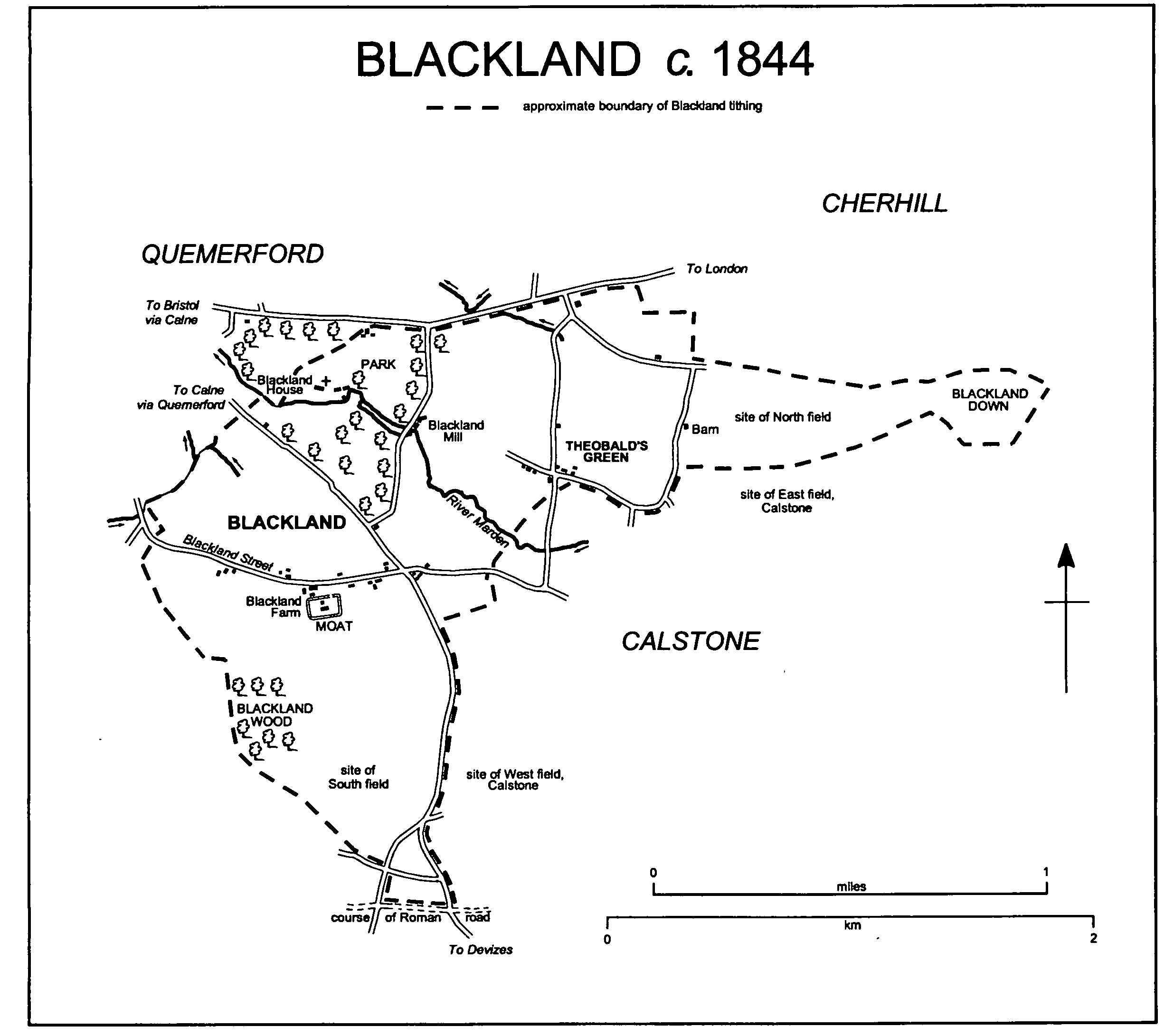
Quemberford is rather interesting because a Robert Blake is said to have owned a fulling mill in Quemerford. Looking at the British History website (https://www.british-history.ac.uk/vch/wilts/vol17/pp17-27 ), and Blackland in particular there is a small map on this page which is rather interesting:

In the writeup about Blacklands the Manor and House both known as Blackland was held by Richard de Canville in 1194 and before that date was part of the King's large estate called Calne. At some point after 1086 the land was part of the Calstone estate and was granted away giving some prehistory to Richard de Canville holding the property in 1194. It then descended in the Canville line with a little bit of interesting history and was given or sold to Malmesbury abbey before 1262. It was then held until 1539 by the Abbey until it was dissolved and the manor then passed to the Crown. It then passed into several families until the late 1780s when it passed to the Maundrell family who apparently held property in Compton Bassett which was called Blake. Somewhat interesting but it does not appear that a Robert (le) Blake held Blacklands at any time. 

Continuing to look at British History Online under Calne:Economic History (originally published by Victoria County History, London, 2002) and Mills, Trade and Industry (Source: 'Calne: Economic history', in A History of the County of Wiltshire: Volume 17, Calne, (London, 2002) pp. 79-94. British History Online https://www.british-history.ac.uk/vch/wilts/vol17/pp79-94 [accessed 12 March 2024])."A fulling mill in Quemberford belonged to Robert Blake (d. 1515 (Public Record Office, C142/31, no. 53)) and was on the estate at Quemerford conveyed by Robert's grandson Thomas Blake to Henry Chivers in 1560." 

 Robert Blake married to Avis (Wallop) (Malwyn) Blake's son John named his brother Robert (married to Margaret Englefield) as heir to the property which included the Fulling Mill at Quemberford in 1504. Their son Roger Blake married to Mary Baynard had a son Thomas who is noted above as inheriting the mill and selling it. This is seen clearly on the Blake Pedigree Chart held by the Swindon and Wiltshire Record Office.


The value of these two charts is quite huge even if over time one notes difficulties with the Chart but overall the parts of the chart that can be verified by records are a great addition to this Blake family. The intent of the Blake Family Chart at the Blake Museum Bridgwater is to illustrate the Blake Family in Somerset and it does it very well actually. I have blogged on it in the past. I did not see it but I am sure it is a treasure to do so especially if you descend from the Somerset Blake line. 

So today finding the Robert Blake record near Speen is most interesting and continues my thought that at some point in the far past (I suspect late 1200s early 1300s) the Calne Blake and the Andover Blake families were related on the female side and their friendship is still seen in the wills in the 1500s. Having so much material in one place whether you might not quite agree with all the entries is a great asset to the Blake family. 

But I  have still not actually proven that Richard Le Blak is the progenitor of the Calne Blake family but I think there are not a lot of choices looking at the Blake records in the 1200s/1300s. The 1274 permit to set up a market was a great opportunity for Richard le Blak in England but there is an effigy in the Rouen Cathedral in Normandy and it wasn't possible to determine exactly who this person was. Perhaps a look at the French records might be in order.