Showing posts with label Blakeland. Show all posts

Sunday, February 9, 2025

So what did I learn about the y-DNA of the group

Sunday today and the service is in London. I shall attend in a bit. It is called Racial Justice Sunday. I believe that everyone under the sun is equal and I thank my mother for making me realize this as a young child when I asked her about the first Black person I ever saw when I was eight years old on the bus going to the Dentist with her. I asked if he had been burned and that was why his skin was black. She said  no that people came in many different shades of skin colour and we were all the same. It was so simply put that it remained with me through my childhood and until now at nearly 80 years of age. I treat all people the same (and some might say it is pretty blunt but I do not want to waste their time or mine). I am simply not a really friendly person just me. 

 Yesterday was a busy day looking at various items but particularly the yDNA of the I-M253 group. First and foremost these individuals are not related in the past 1000 years closely although they share the same line back from I-L22 to I-M253 so thinking they are all from Normandy might be realistic but as their evolution continued forward they took different paths. 

Why did so many people have the surname Blake one might ask in the areas I am looking at - namely Hampshire/Dorset/Wiltshire/Berkshire? Well as demonstrated the wills in the Wiltshire area in the 1500s showed individuals with the Blake surname in Calne, Martin/Marten, Warminster, West Lavington, Playtford, South Newton, Erlestoke, Deverill Longbridge. Looking at Hampshire in the 1500s there were individuals with the surname Blake in Andover, Kings Somborne, Quarley, Knights Enham, Dibden, Lockerley, Penton Mewsey, West Tytherley, East Tytherley, Lymington, Winchester, Christchurch, Ellingham, Mottisfont, Romsey, Boldre, Sparsholt, Isle of Wight (Godshill, Brading). Berkshire  in the 1500s there were individuals with the surname Blake in Speen, Didcot, Bucklebury. 

Just in those four counties there are many Blake families in the 1500s. Getting back into the 1300s is more difficult to look at the Blake families and where they were. The land records seem helpful but I find few records prior to 1200, not many in the 1200s but more in the 1300s. The map I put up showing locations of Blake in the Calendar of Patent Rolls which included the 1300s was interesting. 

The frequency of Blake in the areas mentioned Wiltshire, Berkshire, Hampshire and Dorset rather match the frequency of the wills in the 1500s. So is the family lore wrong or it was just that the Blake family at Calne was the best known of all the Blake families in these areas and if your history (which was likely to individual families) included Normandy as being your family home then one might just assume that you had some sort of a relationship with the Blake family at Calne. 

I decided the next step was to look at the remainder of the people in this group and add them to my chart. The other comment is that only one individual in this group names Robert de Blakeland and the original structure was set up by Barrie Blake who did correspond with many of these people and I just carried it on and fitted them in if their haplogroup fitted which was I-M253. A number have Ireland as their designated country. All but one of the testers was at I-M253 as their level of testing and the addition fits in with the rest of the group. I have really learned all that I can given that the number of Blake testers continues to be too small to really make a point with this data other than they all descend from I-M253 which gives them a sort of ethnic origin that tends to point to Scandinavia as their location 1500 to 2500 years ago (CE). Since the history of this part of France points to a Viking settlement of Normandy between 790 and 1030 (CE) that fits with the data. The Latin documents at this time verifies this movement calling these individuals Nortmanni (men of the North). Putting all of these Blake results into one category works very well and I would not make any changes until we have considerably more Blake testers. But are they all descendant of the le Blak family no and we do not have a tester with a proven line back to Richard le Blak of Rouen, Normandy but I did find some interesting French results in another site. Must find that and republish it here as it was interesting. 

Time for breakfast, yoga first.


Saturday, February 8, 2025

Looking at the yDNA project

I decided to start a new post as I go through the results for members who believe themselves to be descendant (generally family lore which I do tend to listen to) or I have perhaps put you into this category or Barrie Blake before me. Since I do not identify people in our study and look only at the results, all members of this group  belong to I-M253. I have discovered that four members have completed Y-700 which is great news. I tend to leave this project to Bill Bleak but have decided to wade into it because of the chapter in the book. Only one member actually does list Robert de Blakeland which is a synonym for the Blake family of Calne. It is a name that I mostly find in American Blake family histories - when we visited back in 2005 NEHGS (and we have been there many times after) I discovered 16 family histories at that time on their shelf under Blake. I did review them all as we were there for several days and it was curiosity at that time - I was very much a newbie in genealogy then and when Gary Boyd Roberts asked if I had any questions - I said no I knew my line and where it had arisen and where it had been for a very long time especially as my father was born in England and I sat at my grandfather's knee as a young child listening to the story of our family. I suggested if there was time designated to me that he would give it to my husband who had a lot of questions. A marvelous Gary Boyd Roberts; absolutely a fountain of knowledge dealing with the early families into the New England colonies. Other than the Dissenters from England/Scotland in Edward's family (and he had many at the 8x and 9x great grandparent level all in his mother's line) his lines were all from Europe primarily 30% German, 30% Dutch, 15% French, 10% Scandinavian (Swedish primarily) and the remaining 5% Eastern Europe (Poland) and 10% England/Scotland/Ireland. So just a very small percentage and mostly quite ancient in his lines having come to the New England Colonies in the 1600s. So Edward learned a great deal from him and discovered sources he had not yet uncovered. Hence our many trips to this repository through the years. I did not get a tally, Edward probably did, of the number of days we spent in the United States from our first trip there in the late 1960s. In a given year it would have been less than 50 probably but it was for so many years. In all those New England small towns people were so helpful with finding the graveyards way back in the woods sometimes.

So a look at the Haplogroup I-M253 but as I ran my eyes down the table I discovered that there were nine new members so I guess the first process will be to assign them if I am able. Sometimes it takes me a few goes to get them assigned. 

A slight detour but I will publish this and carry on with that assignment and be back later. I have put everyone into a group. Two of the groups I just created R-M343 and J-M304. They are both new and I will do a description in a bit. 

There were three new members to the I-M253 group which is the one that I am looking at as a possibility for the Calne Blake family. I will stay with that group and review all of the data and especially the BigY-700. My life has been pretty busy with my cataract surgery and before that I was pretty much living the groups up to different individuals within the study. For instance there is a leader for B I-M223 and for D1-R-M269 (will correct that heading) as well as  AI-P37 (my brothers' group) and D5-R-M269 as well as E R-M512/R-M198 East Anglia. So a fair amount of coverage and the smaller groups I just slot people into them and hope to find someone within the group who might be able to manage it as these people likely all match each other. I will take time before the next newsletter and make sure that that is true that within these groups people are matching each other. The two groups, one with four people, I will try to work on in the upcoming time before the newsletter. I do write four newsletters a year for the four different projects that I work on so time is limited as I am also writing books. As I approach 80 I want to get it all written down in case someone picks it up in the future although will deposit everything with the Guild of one-name studies of which I am member #4600.

But that is exciting to have new people. 

Now what is known about I-M253? This is a large group and in general these members have listed the Blake family of Calne or discussed it with Barrie Blake back in the past or I have slotted in because you match. I have postulated that the Richard le Blague/Blaake/Blake as the progenitor of the Blake Pedigree Chart produced by the College of Arms from material held by the Daniel Blake family of London, England in 1690 with additions into the 1700s. My comments on this particular Pedigree are many and easily found in my blogs. I do have a disagreement with some of it. But the progenitor is this Richard le Blake and I have postulated that he was from Normandy; applied for a license to set up a market in England in 1274 which was granted. I believe he arrived sometime after this date and located along the Hampshire coast for a period of time and gradually moved inward to Wargrave, Berkshire (this is near Windsor, the seat of power) and then continued this movement towards Speen Berkshire (there was a Blake family there in the 1500s that was associated/related? to the Blake family at Andover (my line). This movement continued until we find them, I postulate that, near Calne and indeed in Calne Wiltshire where a John Blake serves in Parliament which is written up in the Parliamentary Archives (there was a father John Blake I and his son John Blake II who both represented Calne and environs in the Parliament in the late 1300s into the early 1400s).

So a little bit of background on why I am pursuing the information for this group and it is due to family lore to a great extent. In my own line my grandfather along with mentioning that the early British were descendants of one of the Lost Tribes of Israel, the suspicion that the Andover Family was related to the Calne Blake family but I would say that both of these were not something that he was totally attached to but rather repeated it probably as it was said to him as a child. What he was attached to was Nicholas Blake who lived at Old Hall, Enham and just who his descendants were and who his parents were. Strange really perhaps as this man left his will in 1547. Finding a number of cherished documents that repeated this idea that the Andover Blake family was descended from the Calne family in the male line (I argue that this descent was in the female line) I decided to take it on and mention it in the Andover Blake book. I am taking this month of February to concentrate on that very notion and the next item to look at was the Y-DNA and surprise surprise there are four Y-700 results so should be interesting along with the other twelve results. This group has really grown. 

Back to what is known about I-M253. It is generally considered to be Scandinavian arising about the same time as the Bronze Age so it not an old haplogroup and likely arose about 4600 years ago. That is 2600 years (Before the Common Era) and what was happen in the world at that time? Farming and the building up of small communities was starting to be found rather than the hunter-gatherer prior to the Neolithic Period. 


Monday, August 22, 2022

Looking at Blake and an Anne Cole who were said to have married circa 1320s

There is a tree on Geni which I have looked at a number of times but it appears to be based on the research of Horatio Gates Somerby who has been shown to have created genealogies in the Blake family that do not bear scrutiny when compared with extant records. This Robert Blake (and he is also given the surname de Blakeland) is said to be the son of a Robert de Blakeland and Agnes (no surname in this particular genealogy). The basis of this surname is from a small caption which is posted on the website:


The origin of this particular item is intriguing as I could not view it on Geni although I do have a tree on there somewhat tiny at the moment as I have not yet put up a tree but will eventually. 

I have searched the subsidies but have not yet located this particular item. Searching on the text does not reveal this exact wording on the internet although in the past I believe I saw this particular item (the pictured caption) but have forgotten where it was located. 

Blackland does exist on the old maps of Wiltshire and old English does have these two words (blake and black) as somewhat interchangeable. Currently there is a Blackland Park which is said to be close to the Church of St Peter and the Quemberford Post Office. I did find that Quemberford Post office is situated beside Blackland Park on Quemberford Street. 

https://mapcarta.com/W803371347/Map

Enlarge this map hypertext link at least once and you can see the post office on the left right beside the top of Blackland Park. If you continue enlarging then you would find the Church of St Peter (in Calne without, Wiltshire) located in the middle of Blackland Park.

https://britishlistedbuildings.co.uk/101261936-church-of-st-peter-calne-without#.YwJjrxzMKUk

But interestingly these two maps are not concurrent (the first one does show both the Post Office and the Church (you will need to increase the size a couple of times)) but the second one does not show the Quemberford Post Office and as it is the British Listed Buildings I found that somewhat curious unless it is that the Quemberford Post Office is not a listed building which would answer that query. 

Quemberford is rather interesting because a Robert Blake is said to have owned a fulling mill in Quemerford. Looking at the British History website (https://www.british-history.ac.uk/vch/wilts/vol17/pp17-27 ), and Blackland in particular there is a small map on this page which is rather interesting:
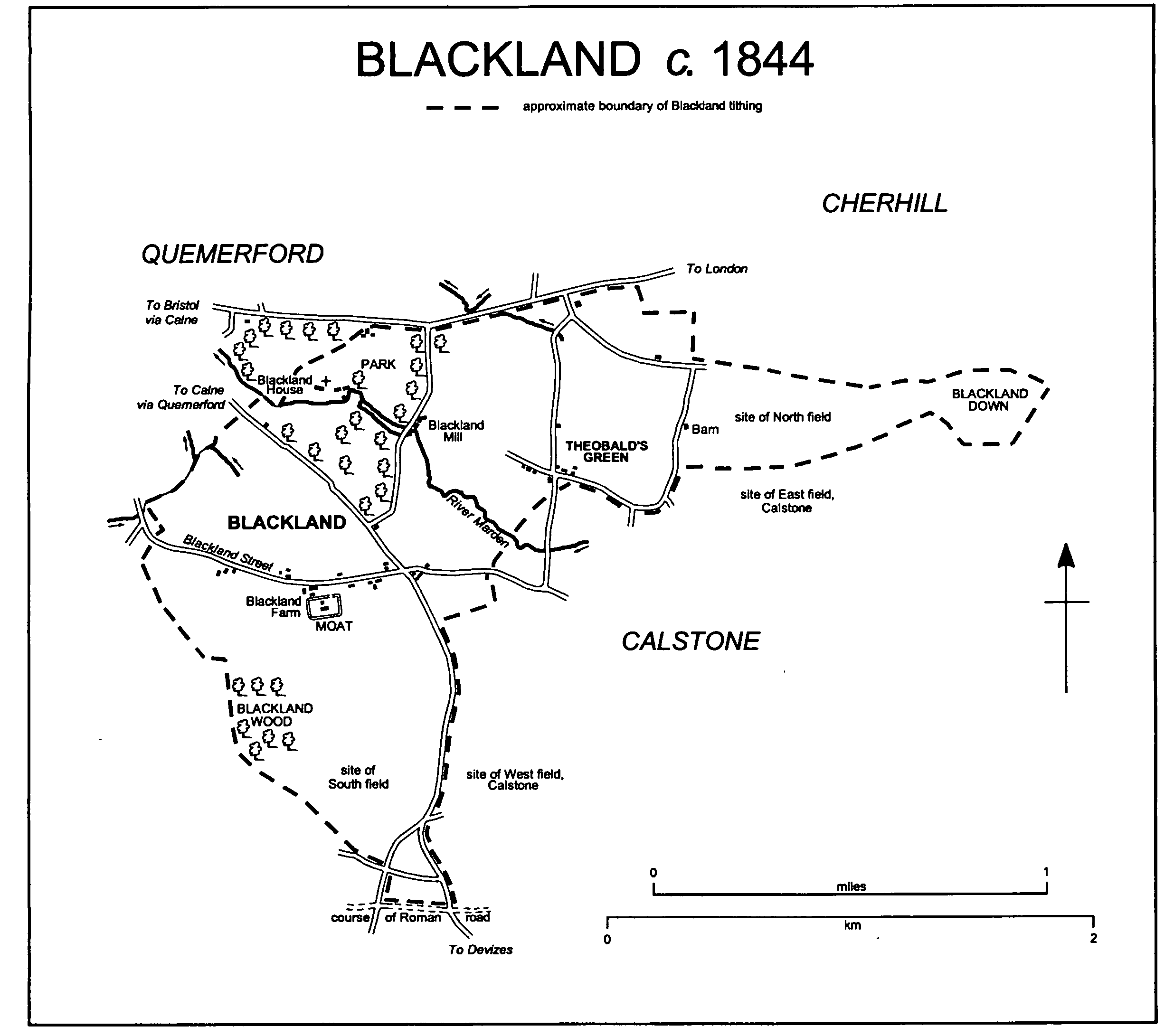
In the writeup about Blacklands the Manor and House both known as Blackland was held by Richard de Canville in 1194 and before that date was part of the King's large estate called Calne. At some point after 1086 the land was part of the Calstone estate and was granted away giving some prehistory to Richard de Canville holding the property in 1194. It then descended in the Canville line with a little bit of interesting history and was given or sold to Malmesbury abbey before 1262. It was then held until 1539 by the Abbey until it was dissolved and the manor then passed to the Crown. It then passed into several families until the late 1780s when it passed to the Maundrell family who apparently held property in Compton Bassett which was called Blake. Somewhat interesting but it does not appear that a Robert (le) Blake held Blacklands at any time but certainly did own a fulling mill at Quemberford. It could be that the Mill which was at Quemberford had to pay a subsidy as it does appear to have been in the family there for a while which might account for the reference but I have not yet found it. 

However Pinhills is an interesting manor and known to be held by the Blake family of Calne. It was a freehold west of Calne and held in 1407 by John Formage conveyed to him by John Pafford. There are several more acquisitions by others but in 1504 it was held by John Blake (at what point in time the Blake family acquired this particular parcel does not appear to be recorded) but by John Blake's will (1504) it passed to his brother Robert Blake and remained in the Calne Blake family until at least 1698 but by 1728 it had been acquired by B. H. Stiles. The actual location of the fulling mill known to be held by a Robert Blake (father of this John and Robert) is not known to me. A google search revealed a couple of hits which could be investigated. A marker on the map (https://www.blacklandsmill.com/contact) does locate a building called Blacklands Mill that is close to the Blacklands estate. All very interesting and certainly Horatio Gates Somerby did tend to spin stories about the Blake family. In the  mid 1800s one could acquire all of this information at the National Archives and perhaps thought that he could get away with constructing a story linking bits of information and ignoring others that proved him wrong. 

Another interesting mention in the British History website under Calne is a comment that an estate in Quemerford was conveyed in 1500 by John Blake to William Reynold so before he died and his will was probated in 1504. 

Prior to the mention of Robert Blake and his Fulling Mill at Quemerford, I have not yet found any information on his parentage other than the charts that are held at the College of Arms and the Wiltshire and Swindon Record Office as well as the Blake Museum at Bridgwater.  

There is on the History of Parliament website a notation that a John Blake II ran for Parliament in 1415 and a Robert Blake ran for Parliament in 1421. It is also mentioned that nine of the fourteen individuals listed in the chart (https://www.historyofparliamentonline.org/volume/1386-1421/constituencies/calne) were members of families long established in the Calne area. John Blake was the son of the man of the same name who had sat for Calne in the early 1380s and Robert Blake is said to probably be their kinsman. Both of these men were said to have had holdings in villages around Calne. 

Hence the father of this John Blake in 1415 is said to be a John Blake. Looking at the Blake Pedigrees held by the College of Arms, the Wiltshire and Swindon Record Office and the Blake Museum one does not find a John Blake son of John Blake listed but Pedigree Charts do not always include all the children in a family. But certainly the Blake family are in the Calne area by these records from the 1380s on into the 1400s and as late as 1698. 

The date for the supposed subsidy was 1286 which is one hundred years earlier than this reference to a John Blake representing Calne at the British Parliament in 1380. We are looking for a marriage for a William Blake and an Anne Cole circa 1320 which is between these two dates. Presumably the Robert de Blakeland referred to as having paid a subsidy for Blacklands in 1286 would have been the father of this William Blake or a grandfather one might surmise. But one does note that the name of the groom married to Anne Cole was given as Robert Blake in the caption on the family tree found on Geni. 

At this point it would be helpful to look at the Pedigrees which I have acquired for the Blake family.

Blake Museum, Bridgwater


This particular chart does mention a Robert (and I think that is le) Blake living at Quemerford with a son Richard who married Ann, daughter of William Cole. The Fulling Mill was held by Robert Blake (at the bottom of this chart) and married to Avis Wallop as determined by the son John. It could be that the Fulling Mill was held for several generations but this information has not become apparent to me. Thus far we now have a Robert de Blakeland (Geni Family Tree), a Richard Blake (Blake Museum Family Chart) and the College of Arms Pedigree Chart listing Richard Blake as the husband of Anne Cole. 


A little bit of sleuthing and looking at the Pipe Rolls of the Bishopric of Winchester 1301-1302 revealed a rather interesting set of Blak family members in Wargrave and Waltham St Lawrence:

Place Surname Forename Date
Wargrave Blak John 1301-2
Wargrave Blak, la Alice 1301-2 (daughter of
Richard le Blak)
Wargrave Blak, le Richard 1301-2
Waltham St Lawrence Blak Hamo 1301-2
Waltham St Lawrence Blak Walter 1301-2 (son of Hamo
Blak)

Wargrave and Waltham St Lawrence are located in Berkshire. It about 8 kilometres from Wargrave to Waltham St Lawrence and they are just north of the county line for Hampshire. It is, however, 100 kilometres to Quemerford. It is known that Richard le Blak received a Licence 30 May 1274 (2 Edward I, volume 1, pages 51-52, Calendar of Patent Rolls) to trade and to carry his wools and merchandise to the usual fairs and markets by the public streets and common ways etc. Interestingly he does or may appear to be there (or a son perhaps) in Berkshire, England in 1301-1302. 

The small item on the tree of the Geni website mentions 1286 and 1347. I have not yet located either of these records but certainly the 1347 date for Robert de Blakeland said to have married Anne Cole daughter of William Cole does bear some scrutiny. It is known that there was a Blake family there in 1380 namely John Blake who was a candidate for Parliament as mentioned above. He would need to have been born by 1359 and could fit into a family of a Robert de Blakeland and Anne Cole. A search on the Discovery Catalogue at the National Archives may be helpful at this point. 

There are three items that could be interesting in a search looking at Quemerford + Blake.

1. Grant (at Calne) by Geoffrey Symple of Wynterbourne Whitcherch (Dorset) to John Blake of Quemerford in 1386 (Reference 1720/199)

2. Grant (at Chippenham) by Richard le Scrivayn of Chippe(n)ham of Licence to his tenant Juliana atte Slow to exchange two acres of arable land at Kemerford (Quemerford in Calne) with Robert le Blake and the date is 1353 (Reference 1720/148).  

3. Attorney: Walker-Heneage and Button family and estate papers, Coker Court, East Coker. By John Blake of Quemerford to Robert Welyknowe to deliver seisin to Rober Saleman and his co-feoffees of pasture of his manor of Shawe and other lands there. Dated, Easter Tuesday (13 Apr 18 Ric (1395). 

Interesting to see that a Robert le Blake was at Quemerford until at least 1353 and then a John Blake from 1386 to 1395 looking at these records. Was this father and son? The Pedigree Chart (all three) list a Henry Blake as the son of Robert de Blakeland and Anne Cole but he could certainly have had a son John as well.  However, one notes that this is a Robert le Blake at Quemerford in 1353. Is this a relative of the Richard le Blak found at Wargrave and Waltham St Lawrence in Berkshire? 

More searching in the Discovery Catalogue and reference to the Blake extractions from the Calendar of Patent Rolls in this time period will help to continue looking at this Blake family. This is a map which I produced a few years ago when I did the extractions from the Calendar of Patent Rolls and this map shows the number of entries in each country for the surname Blake (Blak, etc).


This covers a longer time period and for the 1350 to 1400 time period there will be fewer to examine as to whether or not this can assist in looking at Blake at Quemerford where a Robert le Blake and a John Blake are known to have lived in the time period in question.

 Number    Year    Month    Day    Place    Prefix    Surname    Forename    Location    Relationship    King    Volume    Page #    membrane

192    1323    7    24    Faxfleet    le    Blak    Simon    Hampshire        Edward II    4    374-375    17d
59    1343    5    16    Westminster        Blake    Robert    Hampshire        Edward III    6    87    23d
80    1352    11    26    Westminster    la    Blake    Alice    Hampshire        Edward III    9    368-373    9 and 8
81    1352    11    26    Westminster    le    Blake    Walter    Hampshire        Edward III    9    368-373    9 and 8
82    1352    11    26    Westminster    le    Blake    Henry    Hampshire        Edward III    9    368-373    9 and 8
135    1389    9    15    Clarendon Manor        Blake    John    Hampshire        Richard II    4    112    13
136    1389    9    15    Clarendon Manor        Blake    John    Hampshire        Richard II    4    115    11
141    1392    7    20    Windsor        Blake    Thomas    Hampshire        Richard II    5    134    17
145    1394    2    12    Westminster        Blake    John    Hampshire        Richard II    5    401    18
156    1402    10    13    Westminster        Blake    Andrew    Hampshire        Henry IV    2    197    22d
157    1405    5    22    Westminster        Blake    John    Hampshire        Henry IV    2    448    37
26    1315    7    12    Westminster    le    Blake    John    Berkshire        Edward II    2    405    29d
55    1340    9    18    Andover    le    Blake    John    Berkshire        Edward III    5    95    40d
56    1340    9    18    Andover    le    Blake    Roger    Berkshire        Edward III    5    95    40d
85    1355    11    12    Woodstock        Blake    Adam     Wiltshire        Edward III    10    308-309    12
86    1357    10    21    Westminster        Blake    Robert    Wiltshire        Edward III    10    630    12
95    1365    10    18    Westminster        Blake    Robert    Wiltshire        Edward III    13    168    22
124    1386    1    28    Westminster        Blake    John    Wiltshire        Richard II    3    165    39d
123    1386    2    12    Westminster        Blake    Robert    Wiltshire        Richard II    3    109    32

I have selected Berkshire, Hampshire and Wiltshire as the best places to look at the Blake records in the Calendar of Patent Rolls in this instance. I will continue to look at this information over the next couple of days. I am noting that there isn't a William Blake listed in this information as that is generally the name connected with the Anne Cole marriage by Horatio Gates Somerby and those who copied his work. 

Another interesting set of data to look at is the Emigrants Database 1330 - 1550 but on review the earliest emigrant arrived in 1406 with the surname Blake. Most emigrants who gave a nationality were Dutch with a number identifying as Breton, Fleming, Norman (1524), Irish, Scot and French. 


.


Wednesday, September 12, 2012

Blake marriages at Devon and Dorset 1837 on

I have now completed the Blake marriages at Devon and moved on to Dorset. Dorset has proven to be quite interesting. One of the smaller groups of marriages (less than 430 between 1837 and 1950s or about three or four a year). So far there have only been a couple that I couldn't find on the census. This Blake family is interesting because a descendant of the Blake family at Dorset has written to me about his line. I really have no ideas on the ancestry of this family in particular but I do know that the Blake family at Calne gradually moved down towards the south of England through Wiltshire and into Dorset and Hampshire. Are they descendants of Robert de Blakeland/Richard Blaake/Blake/Blague? yDNA testing may well have the answer to that or again it may not. People change their names; sometimes in a marriage a man stays with the wife's surname for whatever reason; nephews take their uncle's surname in order to inherit from them. There are many reasons for differing results. And of course there are sons born to Blake females out of wedlock that retain their mother's surname. If you know that your line goes back a long way that yDNA testing is surely the way to look at your deep ancestry. If you know that you have a so called non paternal event then you might be able to discover the possible father way back in your line through yDNA studies. It is just such a fascinating new genealogical tool.

I had expected to blog every day but I am catching up on emails and I am still very far behind. Plus a few new test results in the Blake and the Pincombe/Pinkham study have necessitated my looking at them for awhile and then writing to the individuals to see if they wish to become more involved in the study giving genealogical information to help me fit them into family lines. I have a lot of Blake information but if you cannot get back into the late 1700s there is quite a bit of looking to do. I am gradually working through the marriages but it will still be quite a while before I reach the end of my file. I am pleased with being at Dorset in my efforts but there is still a long way to go and then looking at the census to put families together and then make the leap back into the parish registers. A lifetime project but I am glad to have taken it on. Occasionally I contemplate eliminating email from my life entirely and just being in an ivory tower working away on my fiche but the emails do sometimes give me new "meat on the bones" material looking at the Blake and the Pincombe/Pinkham families.

I want to return to transcribing wills once again as well. Perhaps I will try to begin the 1st of October.