Showing posts with label Speen. Show all posts

Monday, February 10, 2025

A new week - basement cleaning

Interesting service on Racial Justice but I have to say that I think anyone that is different from the norm that is around most people does have a more difficult time in life. Some people dislike you automatically because you are different. It is a pity but perhaps it was a reflex on the part of early humans protecting themselves in a new environment - no idea on that really. The answer is just to accept people around you so long as they accept you and respect you. If not than just go your own way and make a life. But maybe that is too simplified. I, being English Caucasian, do not experience dislike because of the colour of my skin so I listen and learn. The dislike that comes my way tends to be for a different reason (unknown to me mostly as I have always lead a quiet life if I was able).  Anyway an interesting service and a welcoming one as a Church should be. When I was a volunteered secretary at Edward's Church I welcomed everyone new that came to ask queries at the table where I was standing in my capacity as volunteer church secretary. As I had learned from my mother at a young age the colour of your skin is a just a property of humanity like tallness etc. If we all felt that way it would be a better place for sure. At coming on 80 years of age I just live a very quiet life writing my books on my parent's families. 

Conrad Black wrote a very interesting editorial on Canada and I must say I am very much in agreement with what he wrote. As usual he captures the essence of the present happenings in a very readable way. 

Worked away on a few items yesterday but it was the rest day for my eyes and today is basement cleaning so will continue on the Latin documents through the day. This month of looking at the le Blak family of Normandy may provide new information that helps with my premise that the Blake family of Calne was descendant of Richard le Blak who received by patent the right to set up a market in England coming from his native Normandy in 1274. Since he was Norman it is highly likely he would quickly climb into a good position in England. Finding a Richard le Blak in Wargrave (near Windsor), Berkshire was an eye opener on the Pipe Rolls of 1301 and knowing that there was a Blake family at Speen, Berkshire in the 1500s that was familiar with/had land dealings with the Blake family at Andover does give me pause to think that linking stories between the Blake family at Calne and the Blake family at Andover may stem from this combination of incidents in the historical record. The historical records for this family have not necessarily all been examined (certainly not by me at this distance away) but finding the various items produced over time by family members and scholars has proven to be a stepping stone linking all of these incidences together and giving them a date that works better into the narrative. 

Why do I do it? Curiosity I think especially about that will of William Blake at Speen, Berkshire dated 10 Jun 1552/probated 28 Jul 1552 - "Item I give and bequeathe amonge all my chyldren to be equally devided / all my shepe and cattell that ys going upon the com[m]ons of Ando[ve]r Enh[a]m and Benh[a]m / Item I give and bequeathe anie of my said cheldren all the graynes that is unthresened and there ofe in the barnes of my holde in Knights Enh[a]m _cells in anye other of my houses then to be equally devided / Item I give and bequeathe amonge my said children all the profytts of my tenement in Knights Enh[a]m whiche William Blake of Knights Enh[a]m doth tyll for me for the somme of fyve pounds to be equally devyded / Item I give and bequeathe to Anthony Blake my sonne the Sixe houses with the ploughe and all th[e ]appurtenances there belonging now in the custody of William Blake with the leasse of my Tenements in Knights Enh[a]m / Item I will that all my goodes and cattalls whiche was removed from Enh[a]m to Benh[a]m to be Removed back agayne to Enh[a]m into the custodye of Robert Boswell my father in lawe Immediatley after my death." 

In this same will - William names his brothers as John and Richard (son is Anthony). William Blake at Knights Enham was the son of Nicholas Blake of Knights Enham who left his will in 1547. William Blake (of Knights Enham) and later at Eastonton left his will in 1582. Nicholas also mentions Robert Boswell in his will. All of these wills I have blogged earlier. The will of William Blake at Speen is very interesting as he was another William Blake with property in Andover but he is not the William Blake married to Avis Ripley mentioned on the Blake Pedigree Chart either as his wife was Ellyne. So the mystery does continue but the facts continue to come out in various documents helping to piece together this period of time and perhaps it will support the premise that I have made. Time will tell. The other part of the curiosity is that my grandfather (and father) actually mentioned this family lore that the Blake family of Andover was related to the Blake family of Calne although not with quite the same attention as they gave to the discussion on Nicholas of Old Hall, Knights Enham. Nicholas, to them, was real. I also did think that William Blake at Speen might be a son of Robert Blake brother to Nicholas Blake but this also was not true as William Blake can be located at Perwell near Andover with his wife Agnes. 

But it does suggest that at some point there was a relationship between these Blake families at Andover and Speen as this is into the 1500s and so we have a period of two hundred years since Richard le Blak was located at Wargrave with Speen being about halfway between Wargrave and Hungerford (Hungerford being in the north east of Wiltshire just over the county border but definitely on a pathway that could lead to Calne). But this William Blake at Speen does not refer to this Blake family as cousin so the relationship was not 1st or 2nd cousin but rather distant perhaps and that is consistent with the time span. 

I also have not found the parents of Robert Blake who left his will at Enham in 1521 (he was elderly for sure as his son Richard left his will in 1522 with older children of his own mentioned). Richard received property at Enham in the will of his father which is then held by Nicholas Blake. This Richard I believe to be the father of Nicholas and Robert (and their sister Elizabeth married to (unknown) Mylne).  There was a John Blake at Andover in the early 1300s and I do need to find that reference as I saw it a dozen years ago in perhaps the Manor Books. Will have to think about that but it was the first reference that I found in Andover to a Blake.

Breakfast finished and Latin next and will set up the I-robot to vacuum the rug in the basement.


Friday, January 17, 2025

Continuing on with the search at Kew

Yesterday interesting details emerged from the search on le Blake and le Blak. The appearance of a le Blake in Southampton prior to the date on which Richard le Blak of Rouen Normandy received his permit to set up a market in England was a surprise as I had not noted that particular item before. There is a Blake line in the southern part of Hampshire around Southampton/Christchurch that stays pretty much in that area although gradually does appear to move upwards into Dorset and Wiltshire as well as Hampshire and there are a number of wills for the Blake family in this area and they do not appear to link to the Blake family in Andover area nor do you see mention of the Blake family members known to be descendant of the Calne Blake family. But there are a number of distinct lines in the Blake yDNA study. This is perhaps one of those that now has three members (must check on that) or more and an excellent researcher in England on that one. But I am trying not to be subjective; I just found it interesting that there was a Blake present in southern Hampshire prior to 1274 when Richard le Blak received his market permit as shown in the Calendar of Patent Rolls. 

Today I want to continue with that search and will soon be doing that. This next month could prove to be interesting as there are many many Blake documents online and forever available to researchers because they are electronic. That is perhaps the gift of our generation to the future. When I first started into computers back in the mid 1960s who would have guessed how far we would come by the mid 2020s. We must continue to be in charge; to manage AI and to make it work for us as it is not limited by the frailty of Homo sapiens and can endure through the ages. It is our gift to the future and we must improve on it every day that lies ahead of us but always be in charge. 

Why do I think Richard le Blak in particular is the ancestor of the Calne Blake family. It is because he was Norman and that would likely give him a boost immediately on his arrival in England. Going to Wargrave makes really good sense because of its proximity to Windsor. Why move towards northern Wiltshire though? Someone with more knowledge than I have would probably quickly see something that was interesting but it does appear they moved towards Speen prior to finding them in northern Wiltshire. Still following that family lore that has (perhaps) a distant connection between the Hampshire Blake family to the Blake family that was at Calne and served as Parliamentarians in 1381, 1383 and 1384. This was John Blake and his son John Blake was born circa 1388 and can be located at Blacklands (a mile SE of Calne) in 1412 when he inherited some family property (I have blogged on that and must check what I wrote). I did blog it 22 Aug 2022 "Looking at Blake and an Anne Cole who were said to have married circa 1320s" and the land was held from 1262 to 1539 by the Malmesbury Abbey. It then passed into private family hands (eventually to the Maundrell family in the late 1780s). We do know that Robert Blake had a fulling mill at Quemberford which is close to Blackland. Source: https://www.british-history.ac.uk/vch/wilts/vol17/pp17-27

The actual location of the fulling mill known to be held by a Robert Blake (father of this John and Robert) is not known to me. A google search revealed a couple of hits which could be investigated. A marker on the map (https://www.blacklandsmill.com/contact) does locate a building called Blacklands Mill that is close to the Blacklands estate.

The connection that hints towards a link to the Calne family appears in the Visitations of one line of the Blake family at Andover in the 1600s and in 1690 (with additions into the 1700s) the Daniel Blake family of London working with the College of Arms created the Blake Pedigree Chart I have mentioned a number of times where a more detailed descent was added. The Blake Museum at Bridgwater holds another large Pedigree Chart (principally linking the Somerset Blake family to the Calne Blake family) but it also mentions the Andover Blake family. Neither of them has the correct parents for William Blake of Eastonton who left his will in 1582 clearly establishing the family lines going back and forward. As do the other wills of this family. Five generations are readily established. I postulate that the connection between the Blake family that was eventually at Calne and the Blake family at Andover were related much further back in the early 1300s. That is the purpose of all this searching and I will spend the next month pursuing this idea in order to form a more concrete proof for this connection if one exists; one that makes use of all the records now available to me. 

I do not plan to publish this book outside of my family particularly but will place it into repositories with the embargo that is is available to family members and academic researchers. Because William, Prince of Wales is descendant, by way of his mother Diana, Princess of Wales, of the Blake family of Calne definitely and I propose that he is descendant of the Blake family of Andover going back to Thomas Blake married to Dorothy Mayowe and the son of Thomas Blake and Eleanor Hall with William Blake married to Elizabeth (unknown) the father of John. This Thomas was the eldest son of John Blake and Margaret (Blake) Blake. Like James Sanders I will leave my thoughts to individuals who may in the future continue this research line and I do so humbly as did he! Certainly life can be very interesting in your old age as you read through all these documents from ancient times. 

My interest is primarily in that ancient ancestor of mine who likely arrived in the British Isles 8000 to 12000 years ago and was named Deer-Hunter by Ethnoancestry on the basis of the yDNA results of two of my four brothers (I could not test one as he was deceased and I really didn't need three results all the same) and this name has remained in the discussion but the more common name would have been Western Hunter-Gatherer. No surname through thousands of years and suddenly his surname is Blake. Why did he chose it? It was an established surname by that time with several families having the surname Blake already in England; I think there needed to be incentive to take on that surname personally. Marriage certainly does provide one with that sort of an incentive. That question I cannot really answer but certainly in the 1300s in England with the Duke of Normandy having conquered England and become its King there would be an asset to marrying into the le Blak family or Blake as it was commonly written by the 1300s. This ancestor was perhaps known as John of Enham in the early 1300s (the Blake family were at Knights Enham in the 1400s) so why not become John Blake of Knights Enham. Now I would say that my grandfather did not really buy into that idea that he was descendant of the Blake family at Calne. He didn't actually believe there was any relationship between Robert Blake, Lord High Admiral, of Bridgwater a line that considered itself descendant of the Blake family at Calne. But he did repeat the family lore along with the idea that the original settlers of the British Isles were one of the Lost Tribes of Israel. Family lore being what it is can sometimes have a moment of truth in it but it can also lead you astray so one proceeds very cautiously in this line of thought.

Breakfast is next, tea is drank, solitaire puzzles all done and even a Sudoku whilst I waited for my kettle to boil and my tea to steep. 

I will continue again to add to this blog through the day. Looking at le Blake 1200-1299 and there are 20 entries 12 completed yesterday). 

Entry 13:  Adam le Blake, 1270, Shropshire Archives 465/4, Grant and quitclaim. An interesting family but I do not think they are connected to the Wiltshire Blake family.

Entry 14: Refers to property and is held by Canterbury Cathedral Archives and Library - 'la blake hege', date 27 Oct 1266 (28 Oct 1265). CCA-DCc-ChAnt/G/116

Entry 15: A similar property and individuals to Entry 14 but does mention a Thomas le Blake and I think is related to Entry 8, 9, 10 in 1200-1299

Entry 16: Refers to land belonging to a church of Blake Nhottele in Essex. 1261-1262.

Entry 17:  Roger Blake and his son Henry, 7 Mar 1294, a gift from father to son it would appear in the Blake family, Knyton, Leicestershire. This Roger Blake is perhaps living at the same time as the gift of land to the Knights Templar by a Roger Blake of Herefordshire (these two counties are fairly close). Leicestershire lies in the same area as Shropshire although somewhat distant apart with Warwickshire between them.

Entry 18. A grant in Swalecliffe once again a record in the Canterbury Cathedral Archives and Library, 20 Nov 1284 - 19 Nov 1285. Thomas le Blake again mentioned. 

Entry 19: Quitclaim (Deeds and Papers), Shakespeare Birthplace Trust DR10/254. A Thomas Blake was a witness, c 1290. There was a Blake family in the Midlands that I have mentioned in another blog and I believe the records available eliminate them from being related to Richard le Blak.

Entry 20: Estate papers of the 4th and 5th Earls of Onslow and one line mentions 1320/273 Copy letters of J Jex Blake, Warren Farm. The holdings of the Earl of Northumberland were extensive and this one refers to the Blake family of Norfolk (East Anglia).

1300 - 1399 (with 98 of these I will only really look at the documents that pertain to Berkshire, Hampshire, Wiltshire and Dorset and possibly Gloucestershire)

Entry 1: Northamptonshire

Entry 2: Worcestershire

Entry 3: Warwickshire

Entry 4: Warwickshire

Entry 5: Warwickshire

Entry 6: Somersetshire - Thomas le Blake of Milverton 1340 DD/SF/1595 (Southwest Heritage Trust)

Entry 7: Northamptonshire

Entry 8: Northamptonshire

Entry 9: same as Entry 1 1100-1199, Worcestershire

Entry 10: Roger le Blake, Madebrook and his grant of land to the Knights Templar 10 Nov 1302 - 19 Nov 1303, C 143/41/23 

Entry 11: Lancashire

Entry 12: Gloucestershire, John le Blake as a witness to the land grant made to Margery le Blake and Nicholas le Blake.3 Jan 1318. BCM/A/2/62/2 (Berkeley Castle Muniments)

Entry 13: Gloucestershire, John le Blake is identified as being of Rockhill, 26 Dec 1330, BCM/A/2/62/5

Entry 14: Lincolnshire, John le Blake and his son Gilbert le Blake, 1317, C 241/113/124

Entry 15: as Entry 14, 1317, C241/82/211

Entry 16: Warwickshire

Entry 17: same as Entry 2 1100-1199

Entry 18: Buckinghamshire

Entry 19: Northamptonshire

Entry 20: Robert le Blake to John Malewayn, grant, 1358, Wiltshire and Swindon Archives 1720/154 (his brother Adam Blake is mentioned)

Entry 21: Robert le Blake paying bond to John Malewayn of Echelhamptone, Wiltshire, 1358, Ref: 1720/152

Entry 22: John le Blake, Cam, Gloucestershire, 16 Aug 1332, BCM/A/1/60/54

Entry 23: Hugo le Blake and wife Katherine, quitclaim, Gloucestershire, 1367, D6322/4

Entry 24: Warwickshire

Entry 25: Warwickshire

Entry 26: Gloucestershire, John son of William le Blake of Rockhill, 3 May 1311, BCM/A/2/62/1

Entry 27: Middlesex, Nicholas le Blake, London, 25 Jan 1349-24 Jan 1350, E 40/1733

Entry 28: Warwickshire

Entry 29: Gloucestershire, John le Blake of Cam, acquisition of land, 1332, BCM/A/1/60/55

Entry 30: Middlesex, similar to Entry 27

Entry 31: Middlesex, London, Nicholas le Blake.

Entry 32: Richard le Blake, Haydon, Wiltshire, 25 Jan 1343-24 Jan 1344, Taxes, E326/6618,  perhaps the son of Margery le Blake. similar to Entry 2: 1100-1199.

Entry 33: Warwickshire

Entry 34: Suffolk

Entry 35: similar to Entry 34

Entry 36: Essex

Entry 37: Gloucestershire, Grant, John le Blake 25 Jan 1338 - 24 Jan 1339, E 210/7780

Entry 38: Staffordshire

Entry 39: Worcestershire

Entry 40: Robert le Blake at Stokkelegh, Wiltshire, 1347, Ref: 1720/137. I have mentioned this in another blog.

Entry 41: Roger Blake, Bodmin, Cornwall, 6 May 1344, C 241/118/364. This is interesting as I have done a number of writeups on the Blake family of Cornwall; must check and see if I have this particular item.

Entry 42: similar to Entry 41: Roger le Blake, 3 May 1343, C241/117/256

Entry 43: John Blake, Gloucestershire, 1391, D2762/T5. Also rather interesting and will check to see if I have looked at this one earlier.

Entry 44: Robert Blake, Stokkelegh, Wiltshire, 1347, Ref 1720/139. Also in another blog.

Entry 45: Warwickshire, place name is Blake Furlong.

Entry 46: John Blake at Whetham, Wiltshire, 1387, Ref: 1720/202

Entry 47: Robert le Blake, Quemerford, 1353, Ref: 1720/148

Entry 48: Humphrey le Blake, Margarethis wife, Roger his son, and John le Blake, Shaftesbury, Wiltshire, Inquisition Ad Quod Damnum, 25 Jan 1347-24 Jan 1348, C 143/286/3.

Entry 49: Lincolnshire

Entry 50: Swaffham, Norfolk, Simon Blake, 1474

Entry 51: Robert le Blake, witness; Grant of Land. 1334, Ref 1720/120.

Entry 52: John le Blake of Rockhill, Shropshire, Nicholas le Blake of Stoke. 19 Jan 1321, Ref: BCM/A/2/62/4.

Entry 53: similar to Entry 52

Entry 54: John Blake, witness, 1395, Ref: 1720/213

Entry 55: Henry le Blake, Shrewsbury, Shropshire, 1343, C 241/117/176

Entry 56: Adam le Blake, London, 1330, Ref: SC 8/92/4572

Entry 57: Leicestershire

Entry 58: Suffolk

Entry 59: Herefordshire

Entry 60: Gloucestershire, Alexander le Blake, 0 Aug 1337, Ref: D326/T171/3.

Entry 61: Warwickshire

Entry 62: Cheshire

Entry 63: Buckinghamshire, Yorkshire

Entry 64: Kent

Entry 65: John le Blake and Alice his wife, 1347, Twyverton, Ref: DD/WHb/583.

Entry 66: Warwickshire

Entry 67: Herefordshire

Entry 68: Robert le Blake, witness, 1345, Ref: DD/WHb/1027-1028, East Coker, Somerset.

Entry 69: Murder of William le Blake, Ogbourne, Wiltshire, 1302,  Ref: SC 8/50/2463 (one of the King's Ministers). I did not see this one before, interesting. 

Entry 70: Suffolk

Entry 71: Lincolnshire

Entry 72: Warwickshire

Entry 73: Robert le Blake, of Kemerford (old word for Quemerford), quitclaim, 1364, Ref: DD/WHb/813 (blogged this item earlier).

Entry 74: John le Blake, witness, Quitclaim, Lega, Hampshire, 17 Oct 1331, Ref: 44M69/C/67

Entry 75: Leicestershire/Rutland

Entry 76: Suffolk

Entry 77: same as Entry 3: 1100-1199

Entry 78: Essex

Entry 79: Suffolk

Entry 80: Warwickshire

Entry 81: Robert le Blake, witness, 1363, Ref: 1720/164, Wiltshire

Entry 82: Christine, widow of Roger le Blake, John le Blake their son, Indented grant by the abbess of Lacock and the messuage is at Lacock. 1350 Dec 30, K H Rogers, Lacock Abbey Charters (Wiltshire Record Society, 1979), no 204. This is quite interesting as John is found at Lacock in a later record. Is he the John Blake that was the ancestor of Humphrey Blake, grandfather to the Admiral Robert Blake on the Blake Pedigree Charts? 

Entry 83: Suffolk

Entry 84: Cheshire

Entry 85: West Sussex

Entry 86: East Sussez

Entry 87: Herefordshire

Entry 88: Leicestershire

Entry 89: John le Blake, Stoke, Devon, witness quit claim, 1341, Ref: 1038 M/T/4/15.

Entry 90: Staffordshire

Entry 91: East Sussex

Entry 92: Warwickshire

Entry 93: Staffordshire

Entry 94: Staffordshire

Entry 95: Staffordshire

Entry 96: Warwickshire, Buckinghamshire

Entry 97: Kent

Entry 98: Essex

le Blak

1200-1299

Entry 1: Thomas le Blak, witness, mentioned in a grant of land, Milverton, Somerset, circa 1280. Very interesting to find a record for Thomas le Blak in Somerset. Reference DD/SF/1591. I think this is the first record I have found for a le Blak in Somerset this early.

Entry 2: Thomas le Blak, Swalecliffe, near Canterbury Cathedral, witness, grant, 20 Nov 1294 x 19 Nov 1295, CCA-DCc-ChAnt/T/17.

Entry 3: Thomas le Blak, Swalecliffe, Quitclaim, 19 Dec 1293, CCA-DCc-ChAnt/T/8.

1300-1399

Entry 1: Nottinghamshire

Entry 2: Thomas le Blak, Milverton, Somerset, grant of land from Thomas to Wm. Vycery, 1321-1322, Ref DD/SF/1593.

Entry 3: Nottinghamshire

Entry 4: William Blak, chaplain, Nottinghamshire, 16Aug 1315, C 241/81/147.

Entry 5: John son of Gilbert le Blak, Lincolnshire, 1333 Mar 26. C 241/104/23

Entry 6: Staffordshire

Entry 7: Suffolk

That completes that run through the National Archives looking at le Blak and le Blake.I will do a search on Blake itself as there are a number of records not caught with this search. 

A couple of surprises and I may order them just to see what is in the items. I have looked up records a number of times so have seen some of these already and worked my way through them. I made a map showing the number of hits in the Calendar of Patent Rolls per country for Blake.


 The time span for these records is 30 Jan 1230 to 16 Jun 1452. I have a copy of every one of these records and generally have used them looking at the families through the last few years but I decided to pull the records from the National Archives although most of them I have seen but this way I know that I have looked at all of them. 

Finished for the day, yoga done, running done, just weight lifting and that is next. No more work today. 


Friday, January 10, 2025

le Blak and le Blake

Reading through the 1200s and 1300s in the Archives (National Archives of the UK) and the really great part of this archives is they also include the Archival databases of the counties in England and other (like Berkley Castle). Eventually the Calne Blake family does end up in Gloucestershire after their mansion house at Pinhills is destroyed by Charles I because Henry Blake would not take a title. But interestingly I am also finding the le Blake family at Cam, Gloucestershire in 1332 leasing land  and the distance to Calne, Wiltshire is close enough (about 50 kilometres). 

Richard le Blak was on the Pipe Rolls at  Wargrave, Berkshire in 1301-2 and with him his daughter Alice la Blak and there is also a John Blak at Wargrave. Near to Wargrave there is Hamo Blak and his son Walter Blak at Waltham St Lawrence. This group of people does rather interest me because there are wills for the Blake family members in the 1500s written in the Speen Berkshire area that mention the Blake family in Andover. It is about 60 kilometres by present day roads which wind about somewhat so perhaps 50 kilometres or could be less. The interesting part is that Speen is closer to Wiltshire and just north of Andover. It may simply be coincidence and I want to avoid convincing myself that the le Blak family found at Wargrave is the Blake family of Calne unless I can find adequate proof. There are a lot of pluses for this thought - this was a Norman family granted a market license in 1274. Certainly Normans often received steps up from King William (Duke of Normandy) although this is two hundred years later. Most influential people were Norman but not all; many of the lords of the manors who existed before the arrival of William the Conqueror were still on their lands (although paying fealty to a Norman overlord for sure).  

The Pedigree Chart for Blake prepared by the College of Arms with material provided by the Daniel Blake family of London in 1690  and this is the top of the Chart.


 This beautiful manuscript is about four feet by twelve feet and is held by the Swindon and Wiltshire Archives. It is possible to purchase eight images that include all of the chart by writing to them. The cost is quite low actually. 

The beginning text reads: "The genealogie of the ancient and worthy family of BLAGUE, BLAAKE or BLAKE, of great antiquity in the county of Wilts, where they had large possessions in Quemberford, Calne and Hilcot with a fair mansion house called PINHILLS, now the seat of the family, a younger branch whereof transplanted themselves into Hantshire and settling at Easton Town, were owners of that and divers other mannor from whence the BLAKEs of Middlesex, etc. are immediately descended faithfully collected out of the several visitation books of the said counties remaining in the College of Arms and deducted to the issue of Daniel BLAKE of London, Anno 1690."

William Blake at Easton Town died in 1582 and this chart is produced just over 100 years later. His will, and over time I have discussed whether there was a possibility of two William Blake individuals living in this area but I have not found anything that would prove the presence of two William Blake lines other than this chart (further down) and the visitations of one particular family. The question in mind though is did Horatio Gates Somerby come across this information and simply link this William to Nicholas because of the wills of both William and Nicholas but then decide on the basis of the Visitations that this was a family descendant in the male line from the Calne Blake family? It is interesting and I have been on this route before but I believe I will devote the next couple of weeks to really looking intently at all the information I have collected; discover if I need to order any more material although I do have quite a bit already and then perhaps make a general conclusion on my thoughts and then move forward to the next stage of the book. It is at such moments that I ponder the thought of being there in Winchester going through the old records but I will leave that for another as it will merit a great deal of attention in the years ahead and I remain with the thought that what I have accumulated can be placed with restrictions to family only and academic researchers. I do not want anyone to publish my work beyond what I publish but using my transcriptions, thoughts and other proofs they can do as they wish with that information.

Time for yoga very shortly. This morning has been very productive thinking wise and I like to have these moments when I just stop and think about what I am doing and where I can go next. 

One of the problems with the text above from the parchment Pedigree is taking the line at Andover back to Roger Blake and Mary Baynard and naming a son William. I have never been able to find in the wills or the Visitations or any other document that they had a son William. That the dating of the death of this William Blake in 1582 and there being a will for a William Blake at such time is provocative because he identifies himself in that will by naming his siblings as the son of Nicholas. Interesting really and it will be an exciting couple of weeks likely as I work my way through everything I have collected including many old records. In my mind is the memory of my grandfather talking about Nicholas Blake and who  he was not. Why would they even do that as Nicholas died in 1547 leaving his will? He was not wealthy by any means although did hold land at Knights Enham. But the attachment of Blake lines to this William (lines that moved away from Andover in the 1600s) leaves one with a great deal to contemplate because a number of these descendants of the Andover Blake family much further down the line did move to America and became interested in their Blake ancestor (even going so far as to test their yDNA which is how I really got into this study of Blake because I have four brothers myself and did test two of them (one was already deceased) and the discoveries on their yDNA were most fascinating especially as they did bring home to me the memory of my grandfather saying this Blake line was always at Andover reminiscent of the language used by the First Peoples here in Canada. It is something that people say who have an extremely long connection to the land. Fascinating really. 

Time for Yoga.


Saturday, March 16, 2024

Wiltshire Archaeological and Natural History Magazine - Volume 9

Nearly spring and the snow is all gone pretty much here. The ground looks dry instead of muddy like it usually is. Time will tell. A yellow sunrise in God's world in the east. What is God thinking as He looks at the world spread out in front of Him? He must have wept for Alexei Navalny - one of His children.  The people of Russia deserve so much more than they are getting - a war is always hardest on its people. Those at the top just live in luxury already greedy for more. The Palestinians here have not brought any children to Canada as far as I can see - they could be safe and well fed here and with very little difficulty since they are little and not a worry; They will not cause any problems for our 600,000 + Jewish people. I think the children is the saddest part; they did nothing to bring this on and it is usual to protect the children and I have a hard time understanding why they are not being protected by people who have all the luxuries of living in Canada. Protest marches are a waste of time - feed the children; bring them to safety.

Very busy working this last week as I spend this "throw-away" month looking at two possibilities - one that Richard le Blak was the founder of the Calne Blake family and two that the Pencombe family at North Molton was descendant of the Pencombe family in Pencombe, Herefordshire. Both have interesting possibilities but provable that is the question. I have looked and looked at the Blake Family Chart on the Blake Museum website (Bridgwater, Somerset) and finally I suddenly saw that perhaps Richard and Robert were interchanged at the top of the Chart and the "proof of life" details for Robert (who has a number of items in various records) did perhaps reveal that they are accidentally interchanged with Richard actually being the father of Robert. There were just too many generations between the two Roberts and not enough years. Perhaps I noted that before but I needed more data on Robert to really see it. With the Pencombe family, not finding a lot of new details but I am just getting into that. Still trying to link Philip Pynkeham at Tawstock but I think one needs to look at land documents to really sort him out. That is not going to happen in my study likely; time will tell.

The Wiltshire Archaeological and Natural History Magazine, Volume 9 (Pages 223-224) which was published in 1866 and is also available from Internet.Archive.org

 http://archive.org/details/wiltshirearchaeo09arch

There is an article in this particular magazine which discusses descent and arms of families and was produced from the notes of the Richmond Herald at the College of Arms about 1693 although he was not appointed Richmond Herald until 1721. The article Wiltshire Arms and Descents was written by Mr. Clarence Hopper and the author of the notes was Robert Dale ( he was perhaps an heraldic painter prior to his appointment is suggested ). The comment is made that the information was principally from the Visitations of 1620 time period.

His notes on the Blague/Blake/Blaake family

Dorsetshire, 27. Blague, alias Blaake, now Blake of Quemberford [Quemerford], Calne and Pynhills - 1st, arg. a chevron between 3 garbs, sab. (this is the usual arms associated with the Blake family). 2nd, arg. on a pile, az. 3 martlets, sil. both by this name. Crest on a chapeau, gu. turned up erm. a martlet, arg. Kent 83.

Blague of Lacock, a second branch from Quemberford. Kent 83

Blague of Hilcot, a third house from Calne. Kent 83

This fits in with the Visitation of 1565 which states that Roger Blake and Mary Baynard had three sons - Thomas at Pynnell, Robert at Lacock and John at Hilcott which matches the information found in the Wiltshire Arms and Descents article mentioned above.

I did review "Index of Persons Named in Early Chancery Proceedings 1385-1467" produced as The Publication of The Harleian Society Volume LXXIX (1928).There are Blake entries namely John Blak, Rawlyn Blak, Richard Blak, Andrew Blake, Edmond Blake, Edmund Blake (6 entries), John Blake (4 entries), Simon Blake (2 entries), Thomas Blake (4 entries), Walter Blake, William Blake (3 entries). 

Name                      Page              Suit#

John Blak                62                 243

Rawlyn Blak          176               345

Richard Blak          62                243

Andrew Blake         3                  69

Edmond Blake      238              174

Edmund Blake     134               319

Edmund Blake     134               325

Edmund Blake     144               240

Edmund Blake     158               606

Edmund Blake     221              164

Edmund Blake     239              204

John Blake           16                 10

John Blake           20               103 

John Blake         204               490

John Blake         295              353

Simon Blake      144              240

Simon Blake      238              174

Thomas Blake   134              329

Thomas Blake   285               74

Thomas Blake   293             307

Thomas Blake   390               13

Walter Blake     154             505

 William Blake   30             131

William Blake    30             148

William Blake  166              88

I will check for Wiltshire, Hampshire, Berkshire in Discovery Catalogue at the UK National Archives for all of these entries.

 John Blak - 13 records from 1300-1499 -  10 are mostly from Norfolk with one from Devon

1. 1400s. Ogbourne St Andrew, Wiltshire C 1/1495/32, grandson William Blake plaintiff. 

2. 1382. Document witnessed by John Blak (dealt with Calne area, Wiltshire).

3. 1489. Thornbury, Gloucestershire E 40/13329-13344. Joan wife of Thomas Pacche daughter and heir of John Blak. Interesting in that the Blake family of Calne is found in Gloucestershire after leaving Calne area.

Rawlyn Blak -  1 record from 1400-1499 - Leicestershire

Richard Blak - 1 record from 1400-1499 - Norfolk

Andrew Blake - 2 records from 1300-1499 - Kent, Sussex

Edmond Blake - 0 records from 1300-1499

Edmund Blake - 12 records from 1300-1499 - 10 Norfolk, 1 Essex, 1 Surrey

To be continued the next Blake day.

Calendar of Patent Rolls and my first task is to check for Robert le Blake and Robert Blake and this is between  1230 and 1452:

1357 21 Oct Westminster  (membrane 12)

Pardon in like terms to John Gosegh merchant of Salisbury on,

his outlawry in the county of Wilts for non-appearance to answer

touching a plea of Robert Blake, Thomas son of Walter de Hungerford

Edward Cokerel and Henry Flemyng,executors of the will of Henry

Russel, citizen of Salisbury, late executor of the will of John

Godhyne late burgess and merchant of Marlebergh that he render

to them 110 l

31 Edward III, volume 10, page 630

One mention only of Robert Blake and it involves a case in Salisbury and Marlebergh which is likely Marlborough and not too far from Calne and Devizes so an interesting find to have a Robert, adult since he is  the executor of a will (although there are exceptions but generally so), in 1357. Continuing proof of life for this Robert and since he is not named at all in the Chancery Proceedings commencing in 1385 he is likely deceased by then as his likely wife Joan and son John were involved in a land transaction in 1386 where Joan is named as a widow. The land mentioned is Shawe by Savernake. I did locate a Shaw in Wiltshire  which is Shaw cum Donnington and of all things it is not too distant from Speen which I mentioned as being another Blake location associated with the Andover Blake family (A genealogical Gazetteer of England, Frank Smith, Baltimore, 1987). It is also close enough to Marlborough which is east of Calne and Devizes. An interesting find perhaps. 

I will have a look for Richard la Blak or Richard Blake in the Calendar of Patent Rolls. The one in Rouen, Normandy,  in 1274 is known as that was his permission to set up a market in England. Any of the references have no connection to Wiltshire. 

So I think Robert le Blake is now verified and the wife of Robert was likely Joan and at least one son John. 


I am tempted though to suspect that Robert is a son of Richard le Blak located at Wargrave, Berkshire in 1301 on the Pipe Rolls of the Bishopric of Winchester. Richard Blague does not bring up any hits on the Discovery catalogue. Is it possible that Robert should come after Richard as his son although not mentioned on the Pipe Rolls at Wargrave but there is a John Blak at Wargrave (although he is not named as a son of Richard in that record). But Robert was not likely born until 1313 or shortly before that and he does name a son John. 

Jumping ahead to Robert Blake  of Quemberford and dates online are 1412-1474 for his lifespan. I was not successful on Wednesday with the middle members of the chart above namely Henry, William and Henry but whipping ahead might be helpful. So if we have a date for the first Robert let us say of 1313 to 1386 then this Robert is born 100 years later approximately. If we eliminate Richard from this line coming down then we are left with Henry, William and Henry. This would have Henry as a son of the first Robert (and I suspect he is born before 1313 so Henry born circa 1330s and a William born circa 1350s and a Henry born circa 1380s and that is likely a reasonable span of years for most generations  (actually short when I consider my own generations). But I am suggesting that Richard le Blak is the father of the first Robert and the two just need to be interchanged. 

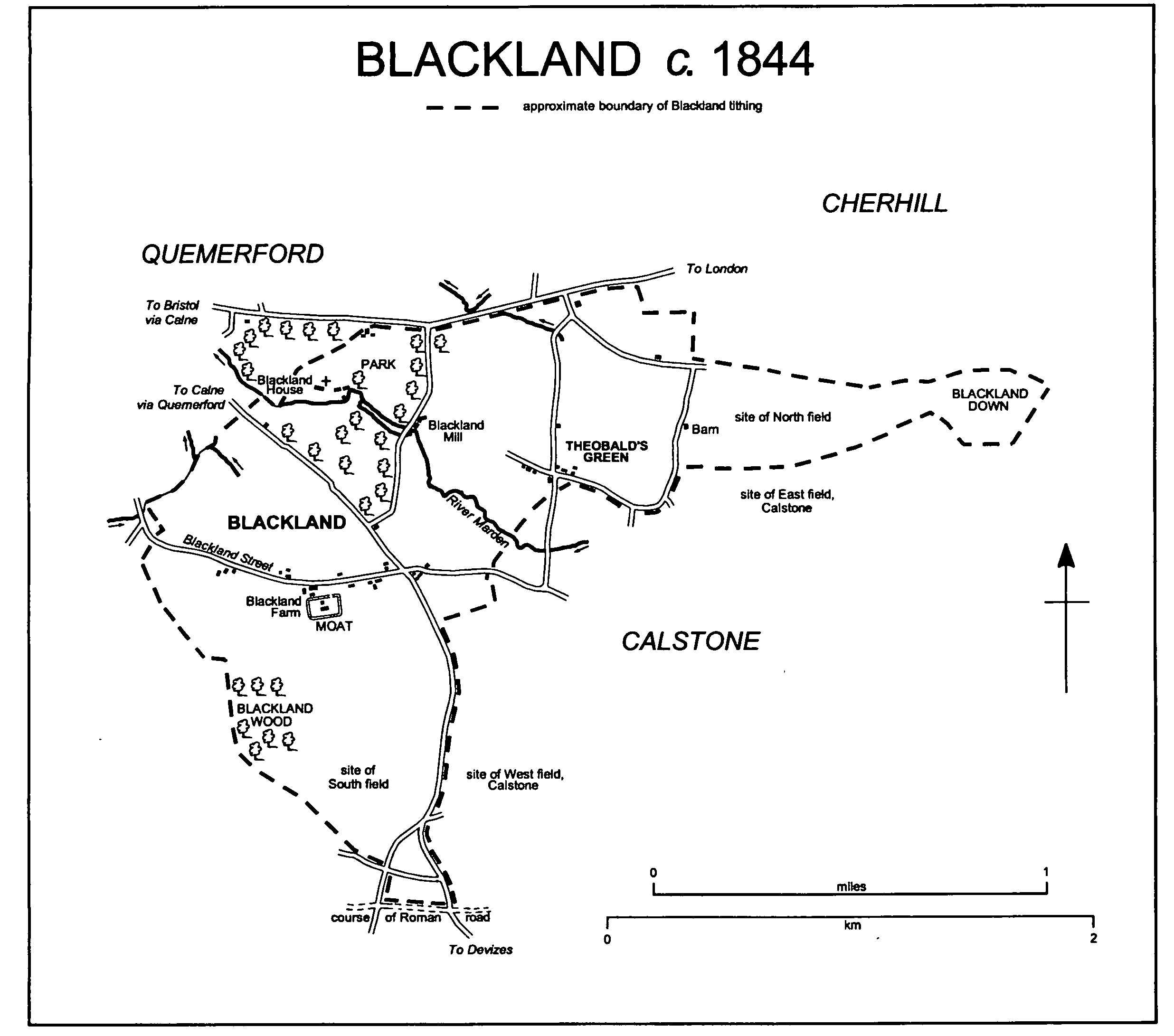
Quemberford is rather interesting because a Robert Blake is said to have owned a fulling mill in Quemerford. Looking at the British History website (https://www.british-history.ac.uk/vch/wilts/vol17/pp17-27 ), and Blackland in particular there is a small map on this page which is rather interesting:

In the writeup about Blacklands the Manor and House both known as Blackland was held by Richard de Canville in 1194 and before that date was part of the King's large estate called Calne. At some point after 1086 the land was part of the Calstone estate and was granted away giving some prehistory to Richard de Canville holding the property in 1194. It then descended in the Canville line with a little bit of interesting history and was given or sold to Malmesbury abbey before 1262. It was then held until 1539 by the Abbey until it was dissolved and the manor then passed to the Crown. It then passed into several families until the late 1780s when it passed to the Maundrell family who apparently held property in Compton Bassett which was called Blake. Somewhat interesting but it does not appear that a Robert (le) Blake held Blacklands at any time. 

Continuing to look at British History Online under Calne:Economic History (originally published by Victoria County History, London, 2002) and Mills, Trade and Industry (Source: 'Calne: Economic history', in A History of the County of Wiltshire: Volume 17, Calne, (London, 2002) pp. 79-94. British History Online https://www.british-history.ac.uk/vch/wilts/vol17/pp79-94 [accessed 12 March 2024])."A fulling mill in Quemberford belonged to Robert Blake (d. 1515 (Public Record Office, C142/31, no. 53)) and was on the estate at Quemerford conveyed by Robert's grandson Thomas Blake to Henry Chivers in 1560." 

 Robert Blake married to Avis (Wallop) (Malwyn) Blake's son John named his brother Robert (married to Margaret Englefield) as heir to the property which included the Fulling Mill at Quemberford in 1504. Their son Roger Blake married to Mary Baynard had a son Thomas who is noted above as inheriting the mill and selling it. This is seen clearly on the Blake Pedigree Chart held by the Swindon and Wiltshire Record Office.


The value of these two charts is quite huge even if over time one notes difficulties with the Chart but overall the parts of the chart that can be verified by records are a great addition to this Blake family. The intent of the Blake Family Chart at the Blake Museum Bridgwater is to illustrate the Blake Family in Somerset and it does it very well actually. I have blogged on it in the past. I did not see it but I am sure it is a treasure to do so especially if you descend from the Somerset Blake line. 

So today finding the Robert Blake record near Speen is most interesting and continues my thought that at some point in the far past (I suspect late 1200s early 1300s) the Calne Blake and the Andover Blake families were related on the female side and their friendship is still seen in the wills in the 1500s. Having so much material in one place whether you might not quite agree with all the entries is a great asset to the Blake family. 

But I  have still not actually proven that Richard Le Blak is the progenitor of the Calne Blake family but I think there are not a lot of choices looking at the Blake records in the 1200s/1300s. The 1274 permit to set up a market was a great opportunity for Richard le Blak in England but there is an effigy in the Rouen Cathedral in Normandy and it wasn't possible to determine exactly who this person was. Perhaps a look at the French records might be in order.


Saturday, February 22, 2014

Robert Blake circa mid 1400s to 1521

Before I move on to the wills that I have managed to transcribe in between Olympic events, I want to think about Robert Blake who wrote his will 16 Dec 1521 and I am quite convinced that it is indeed 1521 and that the Richard who leaves his will in 1522 is his son and the father of Robert, Nicholas and Elizabeth (Mylne).

Robert in his will mentions his son Thomas in particular and Richard occasionally. Thomas is perhaps younger. He also mentions a William Blake and an Andrew Blake but he does not say they are related to him. Robert has given a tenement for life to Andrew Blake.

Richard when he dies in 1522 mentions an indenture with Robert Blake first part and himself, nichi and his wife of the second part at least that would appear to be the correct interpretation as I originally thought it referred to Robert as first son. Richard's wife is still living and he does not name her. He mentions his brother Thomas and that there is a tenament for which he is paying him and this too has something to do with the indenture.

In one of those serendipitous moments, I am seeing that Robert has at least the two sons Richard and Thomas and perhaps a son William but there isn't anything to really prove that. He has perhaps a brother Andrew to whom he has given a tenement for life. Along with that I propose that Richard is the husband of Jone who leaves her will in 1527 mentioning her son Robert, her son Nicholas and her daughter Elizabeth Mylne. She does not give her husband a name.

Thomas and Richard are brothers and the children of Thomas are Margaret (died before Thomas's will was probated), Robert and John. Robert (his son) probates Thomas's will. Is it possible that both men have named their eldest son Robert which is always rather interesting? Is the name of Jone's father Nicholas? Is that the origin of that forename. Is the name of Thomas' wife's father John and again the origin of that forename. The Margaret and the Elizabeth are also interesting but for the most part I am not concerned with the female line of Blake except to note the name of their husbands and possibly their children.

So who is Robert who died in 1521 and what can I learn about him? He is a very generous man remembering many people with a small token. He mentions his sister and a ring for her. His possible brother gets a rent free tenement. Is he quite elderly (perhaps seventy years of age or greater which was a good age in those days? Certainly Nicholas died in 1547 although I suspect his children were only in their 20s at the time giving him a year of birth likely around 1500. Robert has two properties; the one that he lives on where Richard is to live (or is living) and Rawkyns which is to be the home of Thomas. Plus there are his bequests to Andrew Blake and William Blake.

The webpage that talked about a Robert Blake being married to a Maude Snell has long since disappeared and I can not found anything on this particular reference. They were said to be of Benham, Hampshire.But who was this Robert Blake? Can I trace him back any further? Once again the manor papers will likely provide me with information to more fully understand this Blake family at Knights Enham. An obvious pursuit on my next visit to England is to photograph these pages. Unless of course they come on line as more and more material is available on line. In which case we will explore more of England by car; first taking the train to the south of Hampshire and hiring a car and traveling about in south and south west England for a couple of weeks.

The only Benham that I can find is in Berkshire and it is a tything in the parish of Speen. Speen is 15 miles from Andover and 13 miles from Kings Enham. Modern day map shows A34 going south from Speen to Whitchurch where the A303 going west would take you to Andover but there is Red Hill Road/Andover Road from Newbury to Andover. Speen being 1.5 miles northwest of Newbury.

That in itself is quite fascinating as I have transcribed a will for William  Blake of Speen and probated in 1552. This was discussed with the will of Nicholas Blake (blog hyperlink below) because of the mention of Robert Boswell and William has interests at Knights Enham.

http://kippeeb.blogspot.ca/2012/09/will-of-nicholas-blake-national.html

and the will of William Blake at Speen and he lives at Benham

http://kippeeb.blogspot.ca/2012/05/will-of-william-blake-yeoman-of-speen.html

Is this the William in the will of Robert Blake written in 1521? There is no reference to a cousin relationship in the will of William. This William has brothers John and Richard so he is not the son of Robert. He could be the son of William or Andrew mentioned in Robert's will. Interesting the forenames in these various families.

Did I find an answer? No, each new will brings up all sorts of new information, new questions and new thoughts. yDNA testing of Blake descendants in the area of Hampshire/Bershire might provide a few clues as to whether or not this is a founding family which has chosen the surname of Blake at least in the case of my line simply because the yDNA of my brother is said to be pre-historic British Isles well before the Celts, the Romans, the Normans, the Jutes/Angles/Saxons. Why did they choose Blake and for that matter why did so many different founding lines choose Blake? Did they marry daughters of the Blake lines that arrived namely Richard le Blak from Rouen Normandy?

Every time a little tidbit comes my way, it drives my curiosity to continue to pursue all of these Blake lines in England through the wills. The answers lie in those wills, in the manor books of the areas they lived in and the subsidies that they paid in those ancient times.

That I am able to go back to the mid 1400s and find Blake on the land at Knights Enham is telling me that this family in itself is an ancient one and if I am correct that this is my line unbroken back to this time then a truly amazing one in that they were part of the indigenous population of the British Isles that saw immigration after immigration coming to their shores but they survived, they merged with the newcomers and here we are over a thousand years later with some still living in the same area. My grandfather never really left England in his heart; his soul was tied to Upper Clatford and he remembered it to the day that he died. He wanted us to remember it; to see it through his eyes and as an eight year old I listened constantly to his stories about his homeland; his Hampshire. He didn't want his Blake to be lost but to be remembered by his grandchildren and his great grandchildren just as he learned about Blake from his father Edward Blake. He could recite his line going back into time and I wish I had, as an eight year old, written down exactly what he said but he repeated it so many times that getting back to Joseph from Edward (Edward, John, Thomas, Joseph) was easy but the eight year old mind muddled the Thomas, the Williams, the Johns but did hold onto "Old Hall" where Nicholas wrote his will in 1547 (Richard too was lost in my mind).

Friday, April 5, 2013

Will of James Blake, Yeoman of Speen, Berkshire - The National Archives PROB 11/1457/169, probated 13 Mar 1807

The will of James Blake of Speen, Berkshire was a must read given that I had looked at a will for William Blake of Speen from 1552: http://kippeeb.blogspot.ca/2012/05/will-of-william-blake-yeoman-of-speen.html.

Whether or not this James Blake is a descendant of William Blake can not be determined from this will. William Blake had a son Anthony and brothers John and Richard.

A look at British History online for the Parish of Speen does not have any Blake entries. The Englefield family held Speen at the time of William Blake in the 1500s. With no mention of Blake and the knowledge that this Blake family also lived at Andover in some time period, I wonder if they have a similar descent to my line prior to Nicholas Blake who left his will in 1547 at Enham.

From the Spanswick one name study there is a marriage of James Blake to Elizabeth Spanswick 13 Dec 1733 at Speen. http://freepages.genealogy.rootsweb.ancestry.com/~dutillieul/SpansCounty/Berkshire/Speen.html

Transcriber: Elizabeth Kipp
Recorded: 5 Apr 2013
Source: The National Archives, PROB 11/1457/169
Testator:  James Blake, Yeoman
Place: Speen, Berkshire, England
Type of Record: Will
Date of document:  9 May 1805, probated 13 Mar 1807
Read: Electronic copy images
Condition: 19th century English, legible copy

[Margin]: James
[Margin]: Blake

1    This is the last Will
2    and Testament of me James Blake of Speen
3    in the County of Berks yeoman made this ninth
4    day of May in the year of Our Lord one
5    thousand eight hundred and five as follows (that
6    is to say) First I direct all my Just debts Funeral
7    and Testamentary charges and Expences to be paid and discharged
8    and after payment thereof and of every part
9    thereof and subject thereto I direct that my Estate and
10    and Effects of what nature soever be sold and
11    disposed of and converted into Money in such way
12    so my Executor herein after named shall in his
13    discretion think proper and the Money arising
14    and to be made by Sale thereof as also all my
15    Money in the Stocks or Funds and all other my
16    Monies and personal Estate whatsoever I give
17    and bequeath unto William Graham of Newbury
18    aforesaid Draper his Executors and Administrators
19    Upon Trust the said William Graham his Executors
20    or Administrators shall and do within six Calendar
21    Months next after my decease place out and
22    invest the same or any part thereof upon good
23    security or securities or continue the same or
24    any part thereof in and upon such Stocks Funds
25    or Securities as the same or any part thereof
26    may be invested in or upon at the time of
27    my decease as he in his discretion shall think
28    proper and pay and apply the Interest or
30    proceeds of the said Monies so to be placed
    [Page 2]
31    out as aforesaid unto my beloved wife Ann
32    Blake and her assigns or permit and suffer
33    her to receive and take for the same for and
34    during the Term of her natural Life and from
35    and immediately after the decease of my said Wife
36    or as soon after as conveniently m ay be upon
37    Trust that he my said Trustee his Executors or
38    Administrators shall and do call in and pay
39    and divide all and singular the said Monies so to
40    be placed out as aforesaid and all Interest which
41    shall be then due thereon between and amongst my
42    daughter Jane Brown (the Wife of Bartholomew
43    Brown of Newbury aforesaid Pig Cutter whom I
44    had by a former Wife, my Son in Law George
45    Crawford of Grays Inn Lane London Lapidary and
46    Glass Cutter and my daughter Jane Blake) and all
47    and every other Child and Children I may have
48    by my present Wife in equal proportions share
49    and share alike But in case any one or more
50    of them the said Jane Brown George Crawford
51    and Ann Blake or any other Child or Children I
52    may have by my said Wife shall die before
53    his her or their share or shares shall become
54    payable then upon Trust to pay the share or
55    shares of him her or them so dying unto the
56    survivor or survivors of them And I do declare
57    that the Receipt of my said daughter Jane
58    Brown shall be a good discharge to my said
59    Trustee for her share without the concurrence
60    of her husband And I do hereby nominate
61    constitute and appoint the said William Graham
62    sole Executor of this my Will and I do hereby
63    declare that it shall Be lawful for my said Executor
64    and Trustee his Executors and Administrators
65    to deduct and retain to himself and themselves all
66    such costs charges and Expences as he or they
67    shall sustain or be put to in the Execution
68    of the Execution of the Trust of this my
69    my Will and that he or they shall not be
70    answerable or accountable for any more
71    Money than he or they shall actually receive
72    And I do hereby revoke all former and other
73    Wills by me at any time heretofore made and
74    do declare this to be my last Will and Testament
75    In Witness whereof I the said James Blake the
76    Testator have to this my last Will and
77    Testament contained in two Sheets of paper set
78    my hand and Seal to wit my hand at the bottom
79    of the preceding Sheet and my hand and Seal
80    to this Sheet the day and Year mentioned at
81    the beginning of the preceding The Name or Mark
82    of James Blake James Blake the testator The writing
83    contained
    [Page 3]
84    contained in this and the preceding Sheet of
85    paper was signed sealed By the said James Blake
86    the Testator and by him published and declared
87    as and for his last Will and Testament in the
88    presence of us who in his presence and in the
89    presence of each other and at his request have
90    subscribed our Names as Witnesses thereof William
91    Woodward Jno Barfield
92    This Will was proved at London the
93    thirteenth day of March in the Year of Our
94    Lord one thousand Eight hundred and seven before
95    the Right Honourable Sir William Wynne Knight
96    Doctor of Laws Master Keeper or Commissary of
97    the prerogative Court of Canterbury lawfully
98    constituted by the oath of William the sole executor
99    named in the said Will to whom administration
100    was granted of all and singular the Goods Chattels
101    and Credits of the deceased having been first sworn
102    by Commission duly to administer.