Showing posts with label Wallop. Show all posts

Friday, February 7, 2025

Is the John Blake (son of Robert Blake) the same John who was a parliamentarian?

 Still working on the latin document and have picked my way through different parts of it. I  have to think how families that were prominent managed. The Pedigree lists the son of Richard Blague/Blaake/Blake as Henry and there isn't anything (as there is with the Baynard) to show a break (i.e. generations missing) in that chart so his son was said to be Henry and that he was son and heir. Now in British families at this time primogeniture ruled the path so younger sons would go into the military, the church or parliament. If we assume that John was a younger son of Robert (we know this to be correct because the document names Robert Blake (deceased), Joan (unknown) Blake widow, and John the son) then Robert would have had to have been a younger son perhaps since there isn't a Robert on the chart for several generations and that Robert had a Fulling Mill at Quemberford and was married to Avice (Wallop) (Malewyn) Blake. The document is dated 1386 and we know John Blake I (as listed in the Parliamentary Archives died in 1395 leaving a son John (7 years of age and born in 1388 so he is not the John in the document). What I want to gain from the document is some notion of the age of this John Blake I but haven't achieved that thus far. Since Robert was an adult at the time of the first record that I bought  in the 1330s then John Blake I was probably an older person when his son was born. The document synopsis states: "By Robert Devenyssh to Joan widow of Robert Blake and John her son of all his lands in Shawe by Savernake which he acquired from John Wyleye and Robert in Echelhampton. Witnesses: John Lye, John Warneford, John Webury, etc. Dated, Shawe, Fri Feast of St James [25 July] 10 Richard II [1386]. Seal. [Deed damaged by damp - text faint and illegible in places]." 

Perhaps I should be interested in why Robert Devenyssh passed this property to Joan (perhaps he was more interested in it going to his grandson) but I am somewhat suspicious that he was her father and the property was actually going to John himself - no ideas on that but it was perhaps promised at the time of the marriage as part of a dower but to pass to a grandson but again I haven't read the entire document yet. We will see. Anyway wanted to put this down since I was thinking about it. I did do a blog on this Robert Blake determining his proof of life at various times and the first presence I found for him was around 1310 but he would have very young at the time as I was working backwards from a document in the 1330s when he was likely an adult. This Robert did not appear on the 1301 Pipe Rolls for Wargrave but a John le Blak was at Wargrave with Richard le Blak and his daughter Alice la Blake. Since John Blake I died in 1395 leaving a seven year old son John Blake II one is left to think he was possibly older  (i.e. born in the 1330s) having served in Parliament a number of times - principally in the 1380s. That would perhaps place him in the 1380s in his late 40s or early 50s at that time if his father Robert was actually born circa 1310.

I want to have a look at the second document today as well. It is sharper and working with it will be easier. I will keep my blog up to date as I work away today.

Teatime.  

The second document was labeled as a land grant but it has a jagged edge which I understand is usually an indenture but this is a document from 1353 and perhaps when it was a transfer of land between two people they also used that method of recording (which I have now verified; this was an exchange of two acres between two people). So I have begun and this is in much better condition (but I did know that the other had weak spots and fuzzy in places; they say it in the catalogue) and it is between Robert le Blake and another individual. So in 1353 he is old enough to be managing property. Neither his wife Joan or his son John are mentioned in this document. John Blake I would have been born perhaps not long after this although difficult to determine that but he is old enough in 1386 to be on the document so likely by the early 1360s. Moving forward slowly. It is a while since I have read latin documents and this is older latin than I am used to since the wills I transcribed in Latin were from the late 1400s to the early 1500s. 

Is  he the same Robert Blake all the way through? That is always the question in my mind but the land that is being discussed is Kemerford (an earlier name for Quemberford). It is sort of hard to believe that the Blake found at Quemberford in the early 1400s wouldn't be the same Blake family but it is still I think necessary to find as much as I can to support that this is a continuous line of Blake (same family) at Quemberford through the 1300s into the 1400s and still in the 1500s. 

Good day thus far as I have done my Yoga, I cleared away the snow on the patios and then ran for 30 minutes and walked for 15 minutes. This afternoon, after a little more work, I will either do weightlifting or rowing. 

We are not going to be hit with double digit snow levels this weekend only about 5 cm. Sounds good and the more the merrier. The snow is still not that deep in the yard, perhaps half of a metre and we need a metre and a half standing to really have good moisture in the spring. 

An interesting find when I did a quick search on Quemberford:

 https://www.oodwooc.co.uk/ph_quem_aub.htm

 It is a short history of Quemerford and Pinhill and there isn't a mention of the Blake name until the 1600s at Pinhills. There is a discussion on Quemberford which is also rather interesting:


 Wyly surname is on the grant that I am working on actually as a witness. But it is interesting that up to 1335 there is no mention of the Blake family being at Kemerford/Quemberford so this acquisition in 1353 is perhaps the beginning. I believe this plaque is in the Church at Quemberford and the image prepared by D. & M. Ball (as noted on the image above).


Sunday, April 21, 2024

Another Sunday and Blake work yesterday

Another Sunday in Easter - the Fourth Sunday and Church is online in Southwark. My Buller family lived in Bermondsey and attended St Mary Magdalene (also the Beard family as Christopher Buller married Mary Beard at All Hallows Barking by the Tower, London, 30 Dec 1794 (I think it might have been a runaway marriage although Mary was 27 and Christopher was 31 when they wed)) until sometime in the early to mid 1820s. Christopher Buller had been at St Olave as a young man and he was buried there along with Mary (Mary in 1806 and Christopher in 1832). I think perhaps the Church of St Mary Magdalene was the church of the Beard family but Christopher and Mary baptized their children at St Mary Magdalene where Henry Beard married Elizabeth Hemsley 31 Mar 1766. This is a fascinating family and eventually I will get to writing them up but they will be difficult. Perhaps I should be doing it now but God willing my brain will still manage to get around all of that material (plus my latin needs to improve greatly and I work at that every day (at least two times and usually three every day). It is marvelous having Duolingo - works perfectly for me. I also am working on my French but I am fairly efficient at reading but need to improve my spoken French and after one year (September 2025) I will pick up my German once again as it is mostly scientific and it would be interesting to speak a less restricted German. Why, no idea but I am enjoying it because I am a life long learner for sure. Breakfast next and then to Church online in Southwark. We walked and walked the streets of Southwark where the Buller and the Beard family lived. It was fantastic. The Church of St Mary Magdalene was beautiful but had been damaged during the Second World War but a very dedicated group of people are working on its renewal. There are so many churches that I could send money to in England but I have concentrated on the Cathedral here and about 66% of my tithe goes to PWRDF and the other 34% goes to general costs.  

The service was quite wonderful; the homily amazingly perfect to my thoughts of the readings in this time. We have evil war ongoing for those who claim to be the only ones that are perfect in God's image namely Iran with their syncophants  Hamas, Houthis, Hezbollah and for some reason the Russians. They are all terrorists and must clean themselves from the inside for they are satanists. Thank you again for welcoming me from an ocean away to be part of this wonderful Anglican Service which included a young woman of Presbyterian background and someone from Ireland. So many young people as part of the service; the Church needs the youth as always to carry forward the word of God to the next generation.

Whilst working on Blake yesterday, I decided to have a look at the early Wiltshire wills of the Blake and Baynard families. It was an interesting trip actually and at first glance the Wiltshire Blake family wills did not mention the Andover Blake family in the 1500s and 1600s. I transcribed the Baynard family wills as well but I did not see that they mentioned Blake other than Henry at Pinhill. Diana, Princess of Wales, is  descendant of the Baynard family through the Montagu family.  

Diana, Princess of Wales and hence Prince William are descendant of this Baynard family (Mary Baynard and James Montague). Their son James Montagu married Diana Hungerford 30 May 1671 and their son James Montague married Elizabeth Eyles. Their son John Montagu married Sophia Wroughton 15 Dec 1748 and their son George Montagu married Charlotte Wroughton 9 Oct 1783. It was their daughter Georgiana Montagu who married Vice Admiral Sir John Gore 15 Aug 1808 in London. Their daughter Anne Frances Gore married 1st Earl Howe, Richard William Penn Curzon 9 Oct 1845 at Great Witley in Worcestershire. Their daughter Lady Mary Anna Curzon-Howe married 2nd Duke of Abercorn, James Hamilton 7 Jan 1869 in London. Their son James Albert Edward Hamilton, 3rd Duke of Abercorn married Lady Rosaline Cecilia Caroline Bingham 1 Nov 1894 in London. Their daughter Lady Cynthia Elinor Beatrix Hamilton married Albert Edward John Spencer the 7th Earl Spencer 26 Feb 1919 in London. Their son Edward John Spencer the 8th Earl Spencer married the Honourable Frances Ruth Burke Roche and these two were the parents of Lady Diana Frances Spencer. 

Interestingly the Andover Blake line from which Diana, Princess of Wales, follows:  Thomas Blake and Eleanor Hall were the twelfth generation back from Diana, Princess of Wales and Thomas was the son of John Blake married to Margaret Blake (her father not known to me for sure although a Pedigree chart mentions William Blake of Eastontown for both John and Margaret and there were not two by the records!). This John was the son of William Blake of Eastontown and William's father was Nicholas Blake of Enham (The Andover Blake family - William Blake (d 1582) did have a daughter Margaret but her husband was surnamed Jarvis - William left an extensive will). Returning to Thomas Blake and Eleanor Hall and their son Thomas Blake married Dorothy Mayowe and their daughter Mary Blake married William Newland. Mary Newland married Isaac Manley, MP. Their daughter Dorothy Manley married William Gore, MP and their son was Colonel John Gore who married Bellamira Munbee and their son Vice Admiral Sir John Gore married Georgina Montagu in 1808 (and the descent continues as above). Their daughter Anne Francis Gore married Richard William Penn Curzon, the 1st Earl Howe. Their daughter Lady Mary Anna Curzon-Howe married James Hamilton, 2nd Duke of Abercorn. Their son James Albert Edward Hamilton, 3rd Duke of Abercorn married Lady Rosaline Cecilia Caroline Bingham. Their daughter Lady Cynthia Elinor Beatrix Hamilton married Albert Edward John Spencer, 7th Earl Spencer. Their son Edward John Spencer, 8th Earl Spencer married the Honourable Frances Ruth Burke Roche. Their daughter was Lady Diana Frances Spencer married to now HRH Charles III, King of England. 

Does this prove the descent from the Andover Blake Family?, it does but there is a particular item which has chosen to display what I believe is an incorrect ancestry for William Blake at Eastontown. More proof  continues to arise. Is Diana descendant of the Calne Blake family, absolutely the mother of Mary Baynard married to James Montague was Anne (Blake) Baynard daughter of Robert Blake and Margret (Inglefield) Blake. This Robert was the son of Robert Blake and Avice (Wallop, Malweyn) Blake.  I did read again the Baynard family wills in this time frame of the 1500s/1600s to see if there is any mention of Blake cousins but did not find any comment other than referring to Henry Blake at Pinhills their cousin. The Baynard family did have Blake first cousins - Roger Blake and Mary (Baynard) Blake had three sons - Thomas, Robert and John (and three daughters). Perhaps it was the refusal of Henry Blake to accept a title for which Charles II destroyed the Blake family home at Pinhills near Calne. Members of the Baynard family were knighted. No ideas on that; I just think it is interesting in a learning way looking back sometimes at how life flowed in centuries past. Living in the fishbowl takes a very significant part out of your life (namely your privacy!). The dedication of this Family of Windsor has been and continues to be incredible.

The wills (date blogged)

Roger Blake     4 Jan 2013

Philip Baynard     5 Jan 2013

Henry Baynard     6 Jan 2013

Edward Baynard     7 Jan 2013

Benjamin Baynard     10 Jan 2013

Sir Robert Baynard     16 Jan 2013

Edward Baynard     17 Jan 2013

Charles Blake      26 Nov 2013

Edward Blake     28 Nov 2013

Mary Blake (Roger's widow)     4 Dec 2013

James Blake      6 Dec 2013

James Blake     11 Dec 2013

John Blake     12 Dec 2013

The Blake wills are for the Wiltshire Blake family.


Saturday, March 16, 2024

Wiltshire Archaeological and Natural History Magazine - Volume 9

Nearly spring and the snow is all gone pretty much here. The ground looks dry instead of muddy like it usually is. Time will tell. A yellow sunrise in God's world in the east. What is God thinking as He looks at the world spread out in front of Him? He must have wept for Alexei Navalny - one of His children.  The people of Russia deserve so much more than they are getting - a war is always hardest on its people. Those at the top just live in luxury already greedy for more. The Palestinians here have not brought any children to Canada as far as I can see - they could be safe and well fed here and with very little difficulty since they are little and not a worry; They will not cause any problems for our 600,000 + Jewish people. I think the children is the saddest part; they did nothing to bring this on and it is usual to protect the children and I have a hard time understanding why they are not being protected by people who have all the luxuries of living in Canada. Protest marches are a waste of time - feed the children; bring them to safety.

Very busy working this last week as I spend this "throw-away" month looking at two possibilities - one that Richard le Blak was the founder of the Calne Blake family and two that the Pencombe family at North Molton was descendant of the Pencombe family in Pencombe, Herefordshire. Both have interesting possibilities but provable that is the question. I have looked and looked at the Blake Family Chart on the Blake Museum website (Bridgwater, Somerset) and finally I suddenly saw that perhaps Richard and Robert were interchanged at the top of the Chart and the "proof of life" details for Robert (who has a number of items in various records) did perhaps reveal that they are accidentally interchanged with Richard actually being the father of Robert. There were just too many generations between the two Roberts and not enough years. Perhaps I noted that before but I needed more data on Robert to really see it. With the Pencombe family, not finding a lot of new details but I am just getting into that. Still trying to link Philip Pynkeham at Tawstock but I think one needs to look at land documents to really sort him out. That is not going to happen in my study likely; time will tell.

The Wiltshire Archaeological and Natural History Magazine, Volume 9 (Pages 223-224) which was published in 1866 and is also available from Internet.Archive.org

 http://archive.org/details/wiltshirearchaeo09arch

There is an article in this particular magazine which discusses descent and arms of families and was produced from the notes of the Richmond Herald at the College of Arms about 1693 although he was not appointed Richmond Herald until 1721. The article Wiltshire Arms and Descents was written by Mr. Clarence Hopper and the author of the notes was Robert Dale ( he was perhaps an heraldic painter prior to his appointment is suggested ). The comment is made that the information was principally from the Visitations of 1620 time period.

His notes on the Blague/Blake/Blaake family

Dorsetshire, 27. Blague, alias Blaake, now Blake of Quemberford [Quemerford], Calne and Pynhills - 1st, arg. a chevron between 3 garbs, sab. (this is the usual arms associated with the Blake family). 2nd, arg. on a pile, az. 3 martlets, sil. both by this name. Crest on a chapeau, gu. turned up erm. a martlet, arg. Kent 83.

Blague of Lacock, a second branch from Quemberford. Kent 83

Blague of Hilcot, a third house from Calne. Kent 83

This fits in with the Visitation of 1565 which states that Roger Blake and Mary Baynard had three sons - Thomas at Pynnell, Robert at Lacock and John at Hilcott which matches the information found in the Wiltshire Arms and Descents article mentioned above.

I did review "Index of Persons Named in Early Chancery Proceedings 1385-1467" produced as The Publication of The Harleian Society Volume LXXIX (1928).There are Blake entries namely John Blak, Rawlyn Blak, Richard Blak, Andrew Blake, Edmond Blake, Edmund Blake (6 entries), John Blake (4 entries), Simon Blake (2 entries), Thomas Blake (4 entries), Walter Blake, William Blake (3 entries). 

Name                      Page              Suit#

John Blak                62                 243

Rawlyn Blak          176               345

Richard Blak          62                243

Andrew Blake         3                  69

Edmond Blake      238              174

Edmund Blake     134               319

Edmund Blake     134               325

Edmund Blake     144               240

Edmund Blake     158               606

Edmund Blake     221              164

Edmund Blake     239              204

John Blake           16                 10

John Blake           20               103 

John Blake         204               490

John Blake         295              353

Simon Blake      144              240

Simon Blake      238              174

Thomas Blake   134              329

Thomas Blake   285               74

Thomas Blake   293             307

Thomas Blake   390               13

Walter Blake     154             505

 William Blake   30             131

William Blake    30             148

William Blake  166              88

I will check for Wiltshire, Hampshire, Berkshire in Discovery Catalogue at the UK National Archives for all of these entries.

 John Blak - 13 records from 1300-1499 -  10 are mostly from Norfolk with one from Devon

1. 1400s. Ogbourne St Andrew, Wiltshire C 1/1495/32, grandson William Blake plaintiff. 

2. 1382. Document witnessed by John Blak (dealt with Calne area, Wiltshire).

3. 1489. Thornbury, Gloucestershire E 40/13329-13344. Joan wife of Thomas Pacche daughter and heir of John Blak. Interesting in that the Blake family of Calne is found in Gloucestershire after leaving Calne area.

Rawlyn Blak -  1 record from 1400-1499 - Leicestershire

Richard Blak - 1 record from 1400-1499 - Norfolk

Andrew Blake - 2 records from 1300-1499 - Kent, Sussex

Edmond Blake - 0 records from 1300-1499

Edmund Blake - 12 records from 1300-1499 - 10 Norfolk, 1 Essex, 1 Surrey

To be continued the next Blake day.

Calendar of Patent Rolls and my first task is to check for Robert le Blake and Robert Blake and this is between  1230 and 1452:

1357 21 Oct Westminster  (membrane 12)

Pardon in like terms to John Gosegh merchant of Salisbury on,

his outlawry in the county of Wilts for non-appearance to answer

touching a plea of Robert Blake, Thomas son of Walter de Hungerford

Edward Cokerel and Henry Flemyng,executors of the will of Henry

Russel, citizen of Salisbury, late executor of the will of John

Godhyne late burgess and merchant of Marlebergh that he render

to them 110 l

31 Edward III, volume 10, page 630

One mention only of Robert Blake and it involves a case in Salisbury and Marlebergh which is likely Marlborough and not too far from Calne and Devizes so an interesting find to have a Robert, adult since he is  the executor of a will (although there are exceptions but generally so), in 1357. Continuing proof of life for this Robert and since he is not named at all in the Chancery Proceedings commencing in 1385 he is likely deceased by then as his likely wife Joan and son John were involved in a land transaction in 1386 where Joan is named as a widow. The land mentioned is Shawe by Savernake. I did locate a Shaw in Wiltshire  which is Shaw cum Donnington and of all things it is not too distant from Speen which I mentioned as being another Blake location associated with the Andover Blake family (A genealogical Gazetteer of England, Frank Smith, Baltimore, 1987). It is also close enough to Marlborough which is east of Calne and Devizes. An interesting find perhaps. 

I will have a look for Richard la Blak or Richard Blake in the Calendar of Patent Rolls. The one in Rouen, Normandy,  in 1274 is known as that was his permission to set up a market in England. Any of the references have no connection to Wiltshire. 

So I think Robert le Blake is now verified and the wife of Robert was likely Joan and at least one son John. 


I am tempted though to suspect that Robert is a son of Richard le Blak located at Wargrave, Berkshire in 1301 on the Pipe Rolls of the Bishopric of Winchester. Richard Blague does not bring up any hits on the Discovery catalogue. Is it possible that Robert should come after Richard as his son although not mentioned on the Pipe Rolls at Wargrave but there is a John Blak at Wargrave (although he is not named as a son of Richard in that record). But Robert was not likely born until 1313 or shortly before that and he does name a son John. 

Jumping ahead to Robert Blake  of Quemberford and dates online are 1412-1474 for his lifespan. I was not successful on Wednesday with the middle members of the chart above namely Henry, William and Henry but whipping ahead might be helpful. So if we have a date for the first Robert let us say of 1313 to 1386 then this Robert is born 100 years later approximately. If we eliminate Richard from this line coming down then we are left with Henry, William and Henry. This would have Henry as a son of the first Robert (and I suspect he is born before 1313 so Henry born circa 1330s and a William born circa 1350s and a Henry born circa 1380s and that is likely a reasonable span of years for most generations  (actually short when I consider my own generations). But I am suggesting that Richard le Blak is the father of the first Robert and the two just need to be interchanged. 

Quemberford is rather interesting because a Robert Blake is said to have owned a fulling mill in Quemerford. Looking at the British History website (https://www.british-history.ac.uk/vch/wilts/vol17/pp17-27 ), and Blackland in particular there is a small map on this page which is rather interesting:
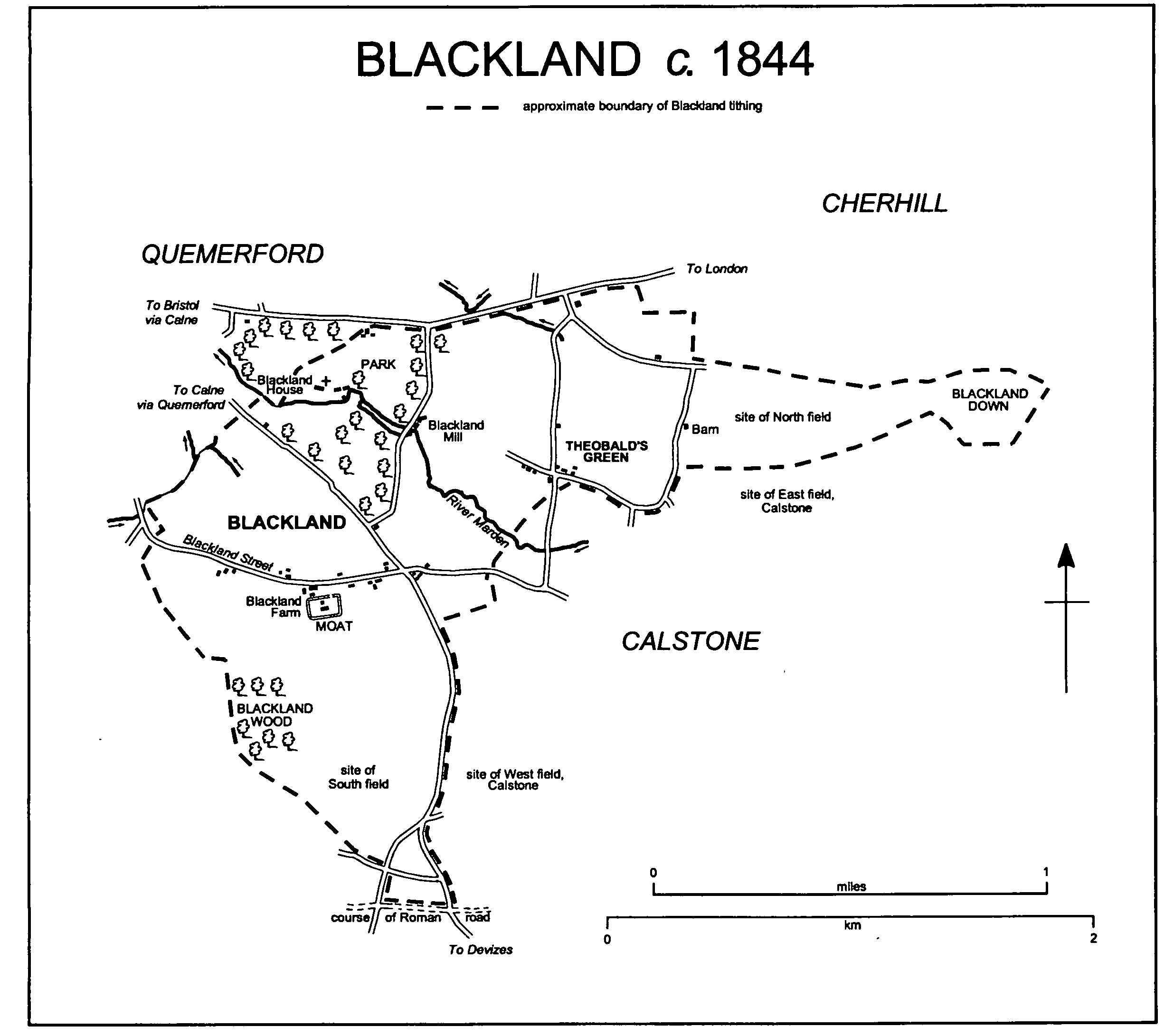
In the writeup about Blacklands the Manor and House both known as Blackland was held by Richard de Canville in 1194 and before that date was part of the King's large estate called Calne. At some point after 1086 the land was part of the Calstone estate and was granted away giving some prehistory to Richard de Canville holding the property in 1194. It then descended in the Canville line with a little bit of interesting history and was given or sold to Malmesbury abbey before 1262. It was then held until 1539 by the Abbey until it was dissolved and the manor then passed to the Crown. It then passed into several families until the late 1780s when it passed to the Maundrell family who apparently held property in Compton Bassett which was called Blake. Somewhat interesting but it does not appear that a Robert (le) Blake held Blacklands at any time. 

Continuing to look at British History Online under Calne:Economic History (originally published by Victoria County History, London, 2002) and Mills, Trade and Industry (Source: 'Calne: Economic history', in A History of the County of Wiltshire: Volume 17, Calne, (London, 2002) pp. 79-94. British History Online https://www.british-history.ac.uk/vch/wilts/vol17/pp79-94 [accessed 12 March 2024])."A fulling mill in Quemberford belonged to Robert Blake (d. 1515 (Public Record Office, C142/31, no. 53)) and was on the estate at Quemerford conveyed by Robert's grandson Thomas Blake to Henry Chivers in 1560." 

 Robert Blake married to Avis (Wallop) (Malwyn) Blake's son John named his brother Robert (married to Margaret Englefield) as heir to the property which included the Fulling Mill at Quemberford in 1504. Their son Roger Blake married to Mary Baynard had a son Thomas who is noted above as inheriting the mill and selling it. This is seen clearly on the Blake Pedigree Chart held by the Swindon and Wiltshire Record Office.


The value of these two charts is quite huge even if over time one notes difficulties with the Chart but overall the parts of the chart that can be verified by records are a great addition to this Blake family. The intent of the Blake Family Chart at the Blake Museum Bridgwater is to illustrate the Blake Family in Somerset and it does it very well actually. I have blogged on it in the past. I did not see it but I am sure it is a treasure to do so especially if you descend from the Somerset Blake line. 

So today finding the Robert Blake record near Speen is most interesting and continues my thought that at some point in the far past (I suspect late 1200s early 1300s) the Calne Blake and the Andover Blake families were related on the female side and their friendship is still seen in the wills in the 1500s. Having so much material in one place whether you might not quite agree with all the entries is a great asset to the Blake family. 

But I  have still not actually proven that Richard Le Blak is the progenitor of the Calne Blake family but I think there are not a lot of choices looking at the Blake records in the 1200s/1300s. The 1274 permit to set up a market was a great opportunity for Richard le Blak in England but there is an effigy in the Rouen Cathedral in Normandy and it wasn't possible to determine exactly who this person was. Perhaps a look at the French records might be in order.